Cut-Glass vs Native Bar Displays: Which One Survives a Real Deployment
Cut-glass versus native bar displays: micro-cracks and edge sealing, yield and cost reality, optical defects, reliability testing and a decision matrix.
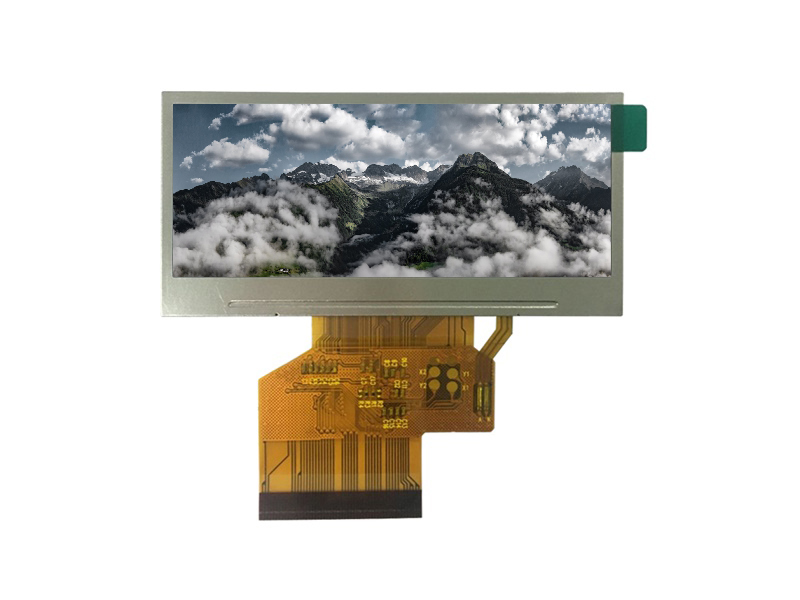
Resizing a standard LCD panel into a bar format is legitimate engineering, and it is also the source of most bar display field failures. The difference between the two outcomes is not the cutting itself but what happens to the cut edge, how it is sealed, and whether the resulting module is qualified for the vibration and thermal conditions it will meet. That is a process question with a measurable answer.
Part of the Bar-Type & Stretched Displays guide — 14 articles on aspect ratios, interfaces and multi-bar networks.
Why cutting a panel is not a manufacturing shortcut
It trades a smaller tooling bill for a longer qualification.
A standard panel is manufactured with its electrical connections, gate driver distribution and edge sealing designed for its own size. Cutting it to a new format removes material that the design assumed would be there, exposes internal layers, and requires new edge sealing and often new FPC bonding. The work is real and skilled; the consequence is that the resulting module is a new product that must be qualified from first principles, not a variant of an existing one.
Where a near-matching native panel exists, that route avoids the entire class of risk. Resizing earns its place when the required format is genuinely unavailable and the product needs it – for example a fixture with a fixed face height that cannot be changed.
Micro-cracks, liquid crystal leakage and edge sealing
The cut edge is where the failure starts.
Cutting glass produces micro-cracks along the edge, and the liquid crystal cell is only a few micrometres thick, so any defect in the seal at the cut boundary becomes a slow leak or a contamination path. Even a crack that does not leak immediately can propagate under thermal cycling or vibration and open a path later. The mitigation is a controlled process: edge grinding and polishing, cleaning, sealing with a qualified material, and inspection that can detect sub-visible defects.
Two process parameters decide the outcome: the quality of the edge preparation and the cure of the sealant. Both should be documented with limits and verified on samples from every production lot, because they cannot be inspected on the finished assembly. CDTech’s notes on custom sizes made by second cutting describe the process boundaries.
Yield and cost reality at different volumes
Cut panels have a different cost curve.
| Factor | Native bar panel | Cut panel |
|---|---|---|
| Tooling | None for the panel | Cutting, sealing, FPC bonding setup |
| Yield | Panel maker’s standard yield | Additional loss from cutting, sealing and handling |
| Qualification | Existing panel data largely transfers | Full retesting of the resized module |
| Format freedom | Limited to available sizes | Almost any dimension |
| Supply risk | Follows the panel maker’s roadmap | Depends on the donor panel’s continuity |
The economics usually favour cutting only when the exact format is a product requirement and volumes are high enough to amortise the setup and the yield loss. At low volume, a native panel in the nearest format with a custom bezel or cover glass usually gives a more reliable product for a similar total cost.
Optical defects introduced by resizing
Cutting changes what you see at the edge.
A resized panel can show edge mura, uneven luminance near the cut boundary, or slight colour variation where the cell gap changes. The polariser is also affected: cutting exposes polariser edges that can lift, and applying new polariser film introduces a lamination step with its own defect classes. These defects are usually visible on a uniform grey field rather than on normal content, which is exactly why the inspection standard for a resized panel must include flat-field views rather than only image content.
Define the acceptance criteria as measurable limits – luminance uniformity, edge defect size, and haze – and inspect against them on every unit. Visual acceptance without a reference will produce disputes.
Reliability in vibration and thermal cycling
The seal and the bond are the two things under test.
A resized module’s weakest points are the edge seal and the FPC bond to the new edge, both of which are stressed by thermal cycling and vibration. The qualification programme should therefore include thermal cycling with functional and optical checks at the extremes, vibration in the production mounting, and a humidity exposure, followed by an inspection of the seal and the bond area under magnification. A module that passes a power-on test after cycling has not been qualified; one whose seal and bond have been inspected has.
CDTech’s material on display reliability testing and on building an optical test setup describes the test structure that applies here.

When a cut panel is the right answer
Four conditions justify resizing.
- No native panel exists within a usable margin of the required format.
- The fixture geometry cannot be changed without redesigning the product.
- Volume is sufficient to amortise setup and to accept the yield impact.
- The supplier can document the edge process, the seal material and a qualification programme.
If any of those is missing, the native route is usually cheaper once field failures and requalification are counted. The comparison is not between two unit prices but between two products’ total risk.
Native panel availability and lifecycle risk
A native format can disappear; a resized format depends on its donor.
Both routes carry lifecycle risk, but of different kinds. A native bar panel depends on the panel maker continuing that format, which for niche formats can be short. A resized module depends on the donor panel continuing to be available in a condition suitable for cutting, and on the resizing process remaining stable. In both cases the practical mitigations are notification agreements, a service stock, and a pre-qualified alternative – for a resized module, an alternative donor or a native format in a slightly different size.
Document the panel identity and the process parameters so that a replacement can be qualified quickly when the time comes.
Interface and driver implications of each route
Resizing changes the electrical design more than buyers expect.
Removing part of a panel changes the gate and source line count and the load the driver ICs see, which is why a resized module normally needs a new or modified driver arrangement and a new FPC bonded to the cut edge. The result is a custom electrical design that must be validated for timing, power and EMC, not merely a mechanical change. Native panels usually offer a documented interface with published timing, which reduces the integration work considerably.
Where a custom mechanical format is unavoidable but the electrical risk is unwelcome, a hybrid approach can work: a native panel with a custom cover glass and bezel that presents the intended aperture and appearance, leaving the panel and its interface standard.
Qualification plan before committing to a design
Qualify the process, then the product.
- Define the format requirement and confirm no native panel meets it.
- Document the edge process: cutting method, grinding, cleaning and sealing material.
- Build a sample lot and measure yield, including edge and flat-field inspection.
- Run thermal cycling, vibration and humidity with post-test seal and bond inspection.
- Verify optical performance against measurable limits, not appearance.
- Agree the per-lot process records that will accompany each shipment.
Workmanship and inspection standards for the bonded FPC and wiring are published by bodies such as IPC, and static-control practice for handling the modules by the EOS/ESD Association. Where the module is used in a sealed enclosure, the relevant sealing definitions are in IEC 60529. Panel format availability from manufacturers such as Innolux and AUO is worth checking before designing around a resized format.
Decision matrix for shelf-edge, transit and equipment use
The application decides how much format freedom is worth.
| Application | Preferred route | Reason |
|---|---|---|
| Shelf edge, near-standard height | Native panel | Formats exist; reliability and supply are simpler |
| Shelf edge, unusual store fixture | Native panel with custom cover glass or bezel | Achieves appearance without panel-level risk |
| Transit information strip, fixed aperture | Native if available; cut only with a full qualification | Vibration exposure raises the cost of any seal weakness |
| Equipment front panel with a defined slot | Native where possible; cut if geometry demands | Long product life makes supply and requalification decisive |
The question to settle at design freeze is not which panel is cheaper, but which route leaves a product that can still be supplied and serviced in five years.
FAQ
Is it safe to cut an LCD panel?
It can be, when the edge is ground, cleaned and sealed with a qualified process and the resulting module is fully requalified for its environment. The risks are micro-cracks, seal defects, liquid crystal leakage and edge mura, and they are managed by process control rather than by inspection alone.
Why do cut panels fail in the field?
Most failures trace to the cut edge or the new FPC bond: a seal that degrades under thermal cycling, a micro-crack that propagates under vibration, or an adhesive edge that lifts. They usually appear after months rather than at first power-on, which is why cycling and vibration testing belong in the qualification plan.
Are cut panels cheaper than native bar displays?
At low volume they are usually not, once setup, yield loss and requalification are counted. They become competitive at higher volume where the exact format is a product requirement. Comparing unit prices without the tooling, yield and qualification difference understates the cut route’s cost.
Can a native bar panel be adapted to a different aperture?
Often yes, using a custom cover glass or bezel that defines the visible area while the panel itself stays standard. That approach captures most of the appearance benefit of a custom format without accepting the edge-sealing and yield risk of resizing.
Next step
Send the required aperture, volume expectation and environmental conditions to CDTech; the reply will identify whether a native format covers the requirement and, where resizing is necessary, what the qualification programme would involve.
Contact sales@cdtech-lcd.com or use the contact page; bar formats are listed under bar-type LCD displays.
Related articles
 Synchronising a Network of Bar Displays: Timing, Drift and Content AlignmentBar-Type & Stretched Displays
 Shelf-Edge Displays for Retail: Brightness, Refresh and Total Cost of OwnershipBar-Type & Stretched Displays2.9 Inch 320×120 Bar TFT: Specs, Interfaces, and Use CasesBar-Type & Stretched Displays
 Custom Bar Display Design: Cutout, FPC, and Bonding ChecklistBar-Type & Stretched Displays