Bar Display Interfaces: RGB, MCU, SPI, LVDS, MIPI
Bar displays—wide, short panels used in transit signs, charging stations, and instrument clusters—are driven by the same five interface families as other TFTs, but the choice plays out differently at bar-shaped resolutions. Small bars…
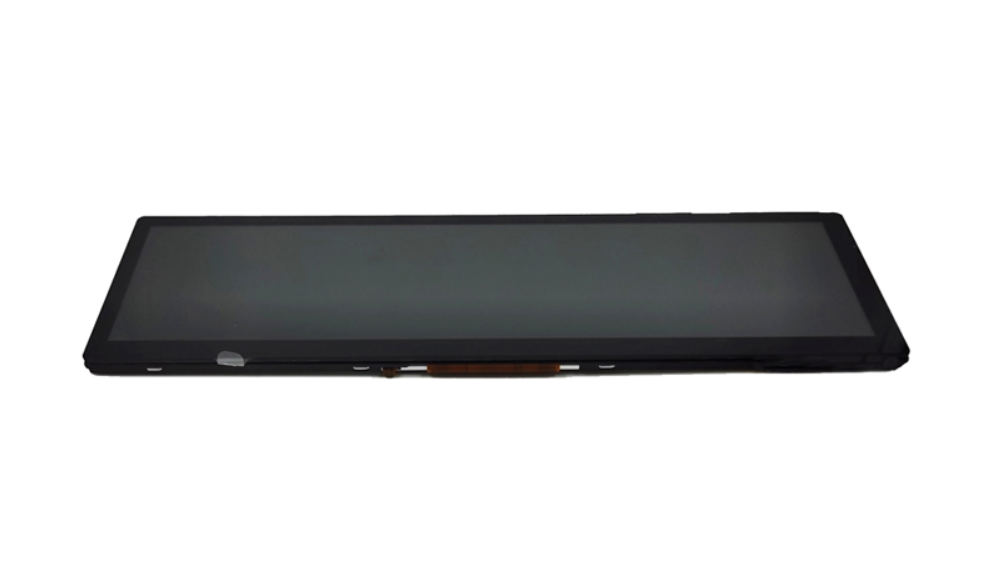
Bar Display Interface Categories at a Glance
| Interface | Typical place in bar displays | Key constraint in a bar build | Dedicated guide |
|---|---|---|---|
| SPI | Small bars, low pin count | Bandwidth limits at higher resolutions and frame rates | SPI vs I2C for small displays |
| MCU (8080/6800) | Small-to-mid bars with a built-in controller | GRAM size and write speed | Display controllers explained |
| RGB parallel | Mid-size bars needing direct host-driven refresh | Pin count and a live timing source | RGB parallel interface guide |
| LVDS / MIPI-DSI | Larger bars and high-resolution formats | Host support and panel ecosystem | LVDS vs MIPI-DSI guide |
If you have not yet decided what kind of bar display your product needs—format, resolution, and environment first—start with the complete bar display selection guide before locking an interface.
Why does a bar shape change the interface conversation at all? Not because of the aspect ratio itself—interface physics are the same on any TFT—but because bar formats cluster into two very different resolution worlds. A ticker-style bar might hold only tens of thousands of pixels, while a large instrument bar can hold more than a million. Those two worlds need different bandwidth, so the interface decision is really a resolution-and-content decision wearing a bar-shaped label.
RGB Parallel in Bar Displays: Pins, Timing, and Limits in Context
RGB parallel is a direct interface: the host drives pixel data over a wide bus while the panel refreshes from that live stream. In a bar context, RGB makes sense when the resolution and refresh need exceed what SPI or an MCU interface can carry comfortably, and when the host already has a parallel RGB controller or LCD controller peripheral.
The practical trade-off is pin count and routing: RGB widths of 16 or 24 bits plus sync lines consume a lot of board space, and the timing must be generated continuously. For the full bandwidth math and when RGB fits a normal rectangular panel, see our RGB parallel interface guide. If your bar is mid-size and your host has the pins, RGB is often the simplest way to get a clean moving image; if the host lacks the timing engine, an MCU-interface panel with its own GRAM may be the better bar solution.
A quick arithmetic check helps: multiply active pixels by the frame rate to get the pixel rate you actually need to sustain. A modest bar at 30 fps might need only a few million pixels per second, which several interface families can carry; a long bar at 60 fps with full motion multiplies that demand several times over. When the number climbs into the tens of millions of pixels per second, RGB-class or serial high-speed interfaces become the realistic answer, and the question shifts to which one your host supports.
MCU 8080/6800 in Bar Displays: GRAM Writes and Refresh in Context
MCU-interface bar panels include a controller with its own GRAM. The host writes pixel data into memory, and the panel refreshes itself from that memory, which means the host does not need to keep feeding pixels continuously. That fits bar displays whose content changes in bursts—status text, icons, or partially updated fields—rather than as a full-rate video stream.
Two limits matter in a bar build: GRAM size (a long, narrow resolution still needs enough memory for the full frame) and write bandwidth (how fast the host can update that memory). If you are choosing between 8080- and 6800-style write timing, or deciding whether your MCU can sustain the update rate, the mechanism is covered in display controllers explained, and host resource planning in choosing an MCU to drive TFTs.
GRAM-based bars are a good match for content that changes in a small region: a clock updating every second, a status line that changes state, or a meter that redraws only its active segment. Because the panel refreshes itself from GRAM, the host can sleep between updates instead of streaming pixels continuously—an advantage in battery-powered or thermally constrained products. The trade-off is that the host writes into memory through a narrower bus, so full-screen video at high frame rates becomes a write-bandwidth problem rather than a panel-refresh problem.
SPI in Small Bar Displays: Speed, Limits, and When It Is Enough
SPI is the lowest-pin-count option and is often enough for small bar panels with modest resolutions and frame rates. Bar formats like a 2.9″ 320×120 panel fit this category well; the host writes frames (or partial regions) over a few wires, and bandwidth stays manageable because the pixel count is low.
SPI stops being the right choice when the resolution or update rate grows: the bus speed becomes the bottleneck, and full-screen video at higher frame rates pushes the required clock beyond comfortable wiring margins. For the bandwidth math and real-world speed limits, see SPI vs I2C for small displays. For a worked example of wiring and initializing a small bar panel from a microcontroller, our small bar TFT driver guide walks through it step by step.
To see why small bars and SPI pair well, do the same pixel-rate check: a 320×120 bar at 30 fps moves about 1.2 million pixels per second, which a typical SPI link handles without strain. The same bar at 60 fps with a color depth overhead is still modest. The crossover comes when the bar gets longer or the content gets faster—at that point the bus clock needed for SPI grows toward its practical ceiling, and an MCU-interface panel or RGB becomes the better engineering choice.
LVDS and MIPI in Larger Bar Displays: Panel and Host Fit
Large or high-resolution bars—long formats with thousands of pixels across—need the bandwidth that LVDS or MIPI-DSI provides. LVDS is common in industrial and automotive bars where the host or a bridge chip already speaks LVDS; MIPI-DSI is the natural choice when the host is an application processor with a DSI output.
The deciding factors are not usually “which is faster” but which interface the host supports, which panels are available in your target format, and what bridge components you are willing to add. Both options also change cable and EMI behavior, which matters in a long, thin product where the display is far from the board. Compare them properly in our LVDS vs MIPI-DSI guide before committing to a panel family.
If your host speaks only LVDS but the available bar panel is MIPI-only—or the reverse—a bridge chip can translate between them. Bridges add cost, board space, and a small latency, so they make sense when the panel of choice is worth keeping; they do not make sense as a way to avoid thinking about the host interface. The migration trade-offs, including when a bridge is justified, are covered in the LVDS vs MIPI guide linked above.
Choosing a Bar Display Interface: Bandwidth and Host Support
Work through the decision in this order rather than jumping to a favorite bus:
- Fix the resolution and content type. Status updates need far less bandwidth than full-motion video at the same resolution.
- Estimate the bandwidth. Multiply active pixels by frame rate; compare it against the interface’s practical limits.
- Check the host. What interface does your processor, MCU, or controller board already expose?
- Check the panel. Which interface variants are available in your bar format and size?
- Add the mechanical cost. A wide bus means more FPC lines and more routing constraints inside a long, narrow product.
| If your bar is… | Start with | Re-evaluate when… |
|---|---|---|
| Very small, low update rate | SPI | Resolution or frame rate grows past comfortable SPI bandwidth |
| Small-to-mid, burst content | MCU (GRAM-based) | Full-frame video or large animations dominate |
| Mid-size, host has RGB controller | RGB parallel | Pin count or routing becomes prohibitive |
| Large or high-resolution | LVDS or MIPI-DSI | Host supports only one; bridge cost decides |
The interface choice also interacts with the rest of the bar build: FPC routing, cutout tolerances, and bonding all change with pin count and signal layout. Our custom bar display design checklist covers those downstream decisions.
One worked example pulls the logic together. A transit ticker that shows scrolling route text on a small bar, updated a few times per second, has low bandwidth and a simple host—SPI or an MCU interface is enough, and partial refresh keeps the host load low. A charging-station bar that plays promotional video at 60 fps needs sustained bandwidth and a host with a display controller—that points to RGB, LVDS, or MIPI depending on the host. The same physical bar could sit in either product; the interface choice follows the content and the host, not the shape.
Frequently Asked Questions
What interfaces do bar displays use?
Bar displays use the same families as other TFTs—RGB parallel, MCU 8080/6800, SPI, LVDS, and MIPI-DSI. The right one depends on bar size, resolution, content type, and host support.
Can a bar display use LVDS or MIPI?
Yes. Larger or higher-resolution bars commonly use LVDS or MIPI-DSI when the host supports them; smaller bars usually do not need that bandwidth.
How is SPI different on a small bar TFT?
SPI on a small bar works the same way as on any small TFT—a few wires carrying pixel data—but the low pixel count of a small bar keeps the bandwidth requirement modest, which is why SPI appears so often in this format.
How do I choose the interface for a bar display?
Fix resolution and content type, estimate bandwidth, then check what your host supports and what interface variants are available in your bar format. Detailed comparisons live in the dedicated guides linked above.
Choosing an interface for a bar panel usually comes down to three inputs: the exact bar size and resolution, the content (static, partial refresh, or video), and the host interface you already have. Send those three details and CDTech will confirm which interface options are available for the format—discuss your bar display requirement or review the bar-type LCD display range.