Building a Display Qualification Test Plan: From Prototype to Production Release
Building a display qualification test plan: environmental, mechanical, optical and electrical tests, sample sizes, acceptance limits and requalification.
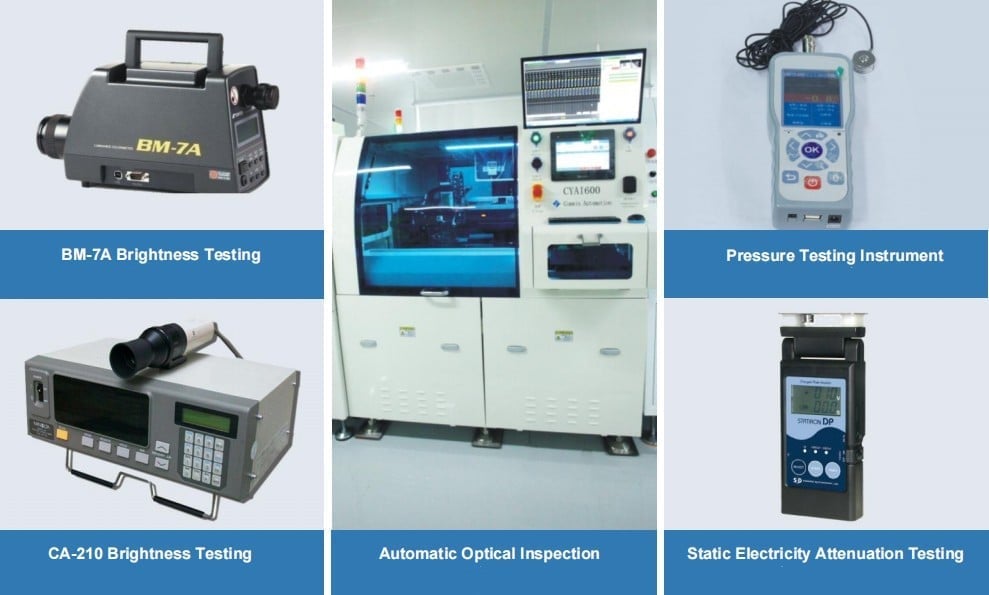
A qualification plan has one purpose: to find the failures that would otherwise be found by customers. That means testing the exposures the product will actually meet, in the mounting and enclosure it will use, with acceptance criteria agreed before the results arrive. Test plans copied from another product usually pass and prove nothing.
Part of the Quality, Testing & Compliance guide — 33 articles on defect classes, inspection, qualification and certification.
What qualification is actually for
It is risk reduction with a defined boundary.
Qualification does not prove that a product will never fail; it demonstrates that the design survives defined exposures with a defined margin, and it produces records that support later decisions. The useful framing is to list the failure modes that matter – condensation, FPC fatigue, adhesive ageing, connector fretting, backlight degradation – and then choose tests that provoke each one. A plan built from a generic list of standards will often test things the product will never experience while missing the one condition that its installation guarantees.
Start from the installation: indoor or outdoor, sealed or ventilated, cleaned or not, handled or fixed. That determines the plan’s shape before any standard is cited.
Environmental tests
Temperature, humidity and cycling, in the real enclosure.
The core environmental set is low-temperature storage and operation, high-temperature operation at full brightness, thermal cycling with power cycling, and humidity exposure combined with cycling. The test conditions should be the internal air temperature at the display, not the ambient figure for the location, and the cycling profile should include the ramp rate and dwell time. A humidity test run without cycling will miss the condensation failures that cycling produces.
CDTech’s material on thermal cycling, humidity and altitude testing describes the structure of these tests and the measurements worth taking at each stage.
Mechanical tests
Vibration, shock and impact in the production mounting.
Mechanical qualification should use the profile from the machine or vehicle manufacturer, applied to the display in its production bracket with the harness connected. The tests that reveal the most are random vibration with accelerometers on the FPC and the cover glass edge, a resonance search before the random run, and shock pulses representing the discrete events the product will meet. Drop testing applies to handheld products, and impact testing to fronts exposed to contact.
Post-test inspection is as important as the test: the FPC bond area, the connector contact resistance and the adhesive edge should be examined under magnification, because these failures do not show up in a power-on check. CDTech’s notes on vibration and shock testing cover the profile information to request.
Optical tests
Measure before and after, not only at the end.
| Measurement | Purpose |
|---|---|
| Luminance at defined brightness settings | Baseline for lifetime and degradation comparison |
| Uniformity across a fixed grid | Detects bonding and backlight issues after cycling |
| Colour coordinates and Delta E | Detects ageing and coating changes |
| Contrast in defined ambient light | Confirms readability in the installation condition |
| Haze and gloss of the front surface | Detects coating wear after cleaning cycles |
Running the same measurements before and after each environmental or mechanical test converts the plan from a pass/fail exercise into a degradation study. CDTech’s notes on measuring brightness, contrast and uniformity describe the measurement method.
Electrical tests
Power, interface and immunity.
Electrical qualification covers supply range and transients, inrush current at the temperature extremes, interface behaviour with the production cable, and immunity to the disturbances the installation provides. EMC testing is usually performed on the finished equipment, but the display’s own contribution should be characterised beforehand so the equipment test is a confirmation. Static discharge testing on the front surface, using a defined contact and air discharge level, belongs in the same plan, with reference practice from the EOS/ESD Association.
Where the display is battery-powered, the plan should include consumption at the brightness levels used in service, since that determines run time and thermal load together.
Lifetime and accelerated ageing
Accelerated tests need a stated acceleration model.
Backlight lifetime is usually expressed as lumen maintenance at a temperature and drive current, and the acceleration from a test condition to the service condition follows a model that should be stated rather than implied. Adhesive and gasket ageing involves both thermal and UV exposure, and the relevant test combines them. Where a claim will appear in a customer document, the test conditions, the model and the resulting estimate should all be recorded, because a bare number cannot be defended.
A defensible approach is to test at two or more stress levels and show that the degradation follows the assumed model, rather than extrapolating from a single point.
Sample sizes and acceptance criteria
Decide the numbers before the results arrive.
Sample size follows the purpose: a few units for a development check, a statistically meaningful sample where a specification limit is being demonstrated, and a defined number of failures that stops the test. Acceptance criteria should be numeric wherever possible – luminance within a percentage of baseline, uniformity within a limit, insulation resistance above a value – and qualitative criteria should be supported by boundary samples agreed in advance. Agreeing the criteria before the test removes the most common source of dispute, which is a disagreement about whether a result passed.
Where a test is destructive, plan the sample allocation so that the optical and lifetime assessments do not consume the units needed for the mechanical programme.

In-house versus third-party labs
Both have a place.
In-house testing is fast, cheap and repeatable, and it suits development iteration and pre-compliance checks. Third-party laboratories provide accredited methods and independent records that customers and regulators accept, and they are usually essential for certification-related testing. The efficient pattern is to develop and iterate in-house, then run the definitive programme at a laboratory, with the in-house results used to predict the outcome.
Laboratory scopes for environmental, ingress and EMC testing are published by organisations such as Intertek and TUV Rheinland, and chamber capability by suppliers such as Thermotron and Weiss Technik.
Documenting results for later disputes
The record is part of the deliverable.
- Test conditions: profile, ramp rates, dwell times, cycle counts, temperatures.
- Configuration: module revision, firmware, mounting arrangement, cable type.
- Measurements: instrument, geometry, values before and after.
- Observations: photographs of the assembly and of any defect, at defined magnification.
- Disposition: what was concluded, and what change (if any) followed.
Twelve months later, this record is the only way to answer whether a field issue is related to a test that was passed. Workmanship and inspection standards referenced in the report are published by bodies such as IPC, and environmental ingress levels by IEC, including IEC 60529.
Re-qualification triggers after a change
A change to the assembly invalidates part of the evidence.
Any change to the panel, adhesive, cover glass, coating, printing, FPC, driver board or production site may affect the results, and the plan should state which tests are repeated for which category of change. In practice, the expensive part of requalification is not the test itself but deciding whether it is needed; a change matrix, agreed at the start, answers that question in a meeting rather than in a debate. CDTech’s notes on second-source qualification describe a similar evidence set for a new source.
The matrix should also state which changes can be accommodated with documentation only, and which require customer notification. That distinction is what keeps a programme’s certification intact while allowing ordinary process improvement.
FAQ
What tests should a display pass?
It depends on the installation: temperature and humidity cycling in the enclosure, vibration and shock in the production mounting, optical measurements before and after, electrical and ESD tests, and a lifetime assessment for the backlight. The plan should follow the product’s real exposures rather than a generic standard list.
How many samples are needed for qualification testing?
A development check may use a few units; demonstrating a specification limit needs a statistically meaningful sample, and the acceptance criteria and the number of failures that stops the test should be agreed before testing begins. For destructive tests, allocate the samples across programmes so the optical work is not starved.
Should qualification testing be done in-house or at a third-party laboratory?
Develop in-house where iteration speed matters, then run the definitive programme at an accredited laboratory when the results must support certification or a customer submission. Use the in-house results to predict the laboratory outcome and to fix problems before paying for the formal run.
When does a change require requalification?
When it can affect a characteristic that was tested: a change of panel, adhesive, glass, coating, print, FPC, driver board or production site. Agreeing a change matrix at the start of the programme makes the decision mechanical rather than a matter of opinion each time.
Next step
Send the installation conditions, enclosure design and required evidence to CDTech; the reply will propose a qualification plan with the test conditions, sample allocation and acceptance criteria for each exposure.
Contact sales@cdtech-lcd.com or use the contact page; quality system scope is published on the certifications page.
Related articles
Second-Source Qualification for Display Modules Without Doubling Your Inventory RiskQuality, Testing & ComplianceIncoming Inspection for Display Modules: What to Check and How OftenQuality, Testing & ComplianceEMC Certification for Display Products: Passing the First TimeQuality, Testing & Compliance Screen Damage Modes: Distinguishing Production Defects From Field DamageQuality, Testing & Compliance