Burn-In Versus Image Retention: Telling Them Apart
Burn-in versus image retention: how the two differ, the test that tells them apart, why LCDs behave differently and how static HMIs are specified. | Target URL: https://blog.cdtech-lcd.com/burn-in-vs-image-retention/

The two terms describe different failures that look similar in a photograph: a ghost of a previous screen that stays visible after the content changes. One is temporary and reversible, the other is permanent ageing. The distinction decides whether the answer is a content change, a specification change or a replacement – so the first task is the test that separates them.
Part of the Quality, Testing & Compliance guide — 33 articles on defect classes, inspection, qualification and certification.
What each term means
Retention is a lingering charge state; burn-in is permanent material change.
Image retention is the temporary persistence of a previous image, caused by the liquid crystal or the driving circuit holding a state slightly longer than it should; it fades when the content changes or after the panel rests. Burn-in is a permanent change in the light-emitting or light-modulating materials, so the ghost remains at the same contrast regardless of what is displayed. Only the second is an ageing failure.
Because both appear as a ghost, the naming matters: calling retention “burn-in” starts an unnecessary replacement conversation, and calling burn-in “retention” delays a legitimate claim.
The mechanism of image retention in LCDs
Charge accumulates where the same state is held for a long time.
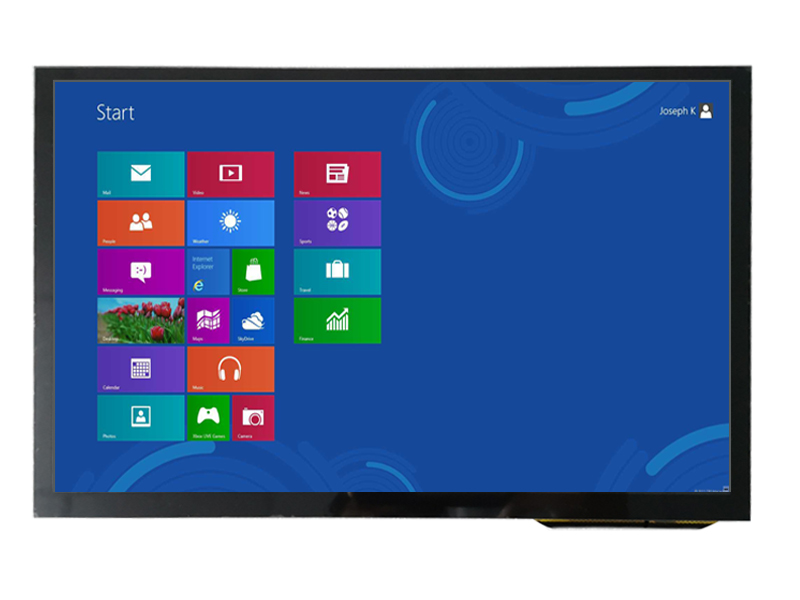
An LCD pixel is driven by a voltage held on a capacitor through a thin-film transistor. When one region holds a similar voltage for hours, ionic impurities in the liquid crystal can migrate towards the alignment layers and the effective field changes slightly, so the region switches a little less completely than its neighbours. The effect is strongest in static interfaces with bright, high-contrast elements that stay in the same position. CDTech’s notes on industrial and consumer displays are relevant here: an industrial panel is designed for long static duty, which is why retention behaviour is part of its specification.
The practical significance is that retention is a design and content issue as much as a panel issue.
The mechanism of permanent ageing
In an LCD it is uneven ageing; in an emissive display it is differential decay.
In an emissive display such as OLED, different subpixels age at different rates depending on how much current they have carried, so a static bright element leaves a permanent shadow. In an LCD, permanent unevenness usually comes from differential ageing of the backlight or from material changes in the cell and polarisers rather than from pixel state, which is why a static interface on an LCD typically produces retention rather than a true burn-in pattern. LED backlights age unevenly across units, which is covered in CDTech’s notes on LED binning and brightness matching.
The consequence for specification is that an OLED static interface carries a real ageing risk while an LCD one usually carries a retention risk.
The test that tells them apart
Display a uniform mid-grey field for a defined time and measure.
After the suspect static image has been displayed, replace it with a uniform grey field and photograph or measure the screen at several intervals. Retention fades measurably within minutes to hours; permanent ageing does not change at all. Repeating the observation after a power cycle and after a thermal cycle adds confidence, because retention often reduces after the panel rests while ageing is unaffected.
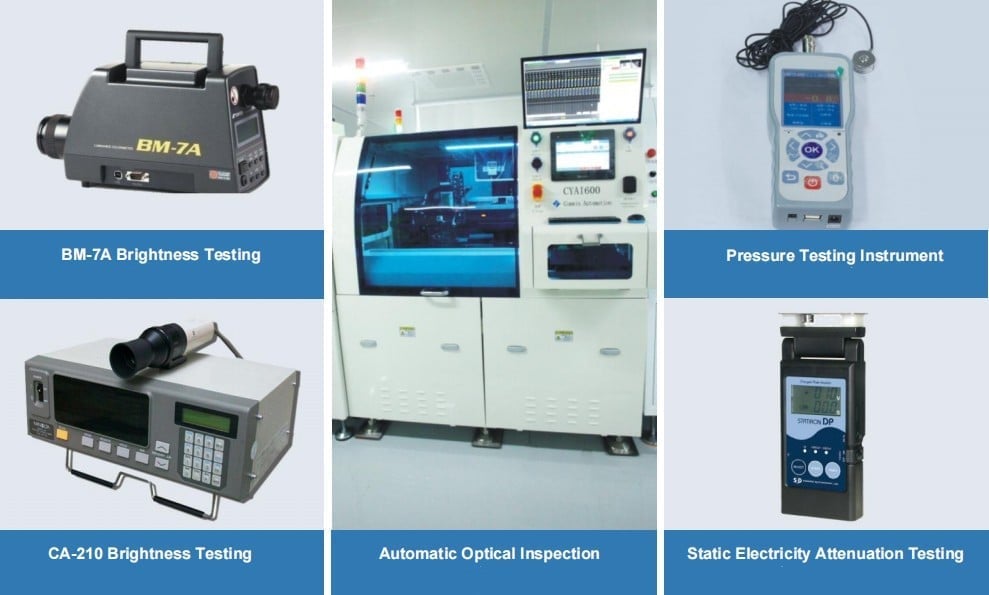
The measurement is more convincing than a photograph: a luminance reading at the ghost region compared with an adjacent unaffected region, taken at fixed intervals, produces a decay curve that settles the question.
Why LCDs rarely burn in but often retain
The distinction is between a temporary electrical state and permanent material change.
LCD pixels are light valves rather than light sources, so operating them at a fixed state does not consume the material the way driving an emissive pixel does. What changes with long static operation is the distribution of ionic charges and, over years, the ageing of the backlight and polarisers. The visible outcome in an industrial HMI is usually a ghost that fades, not a pattern that stays.
That is also why retention is more common in interfaces that keep one bright element – a large numeric value, a status bar – in the same position for months.
Static content in industrial HMIs
Control rooms and machine panels are the worst case for retention.
An HMI that shows the same layout continuously for a year holds some pixels in one state for thousands of hours, which is exactly the condition that produces retention. The preventive measures are content-side: dim after inactivity, move static elements imperceptibly, use a darker interface theme, and avoid a permanently bright large field next to a dark one. These cost nothing at design time and are more effective than any panel specification.
Where the interface cannot change, the display can: a panel designed for long static duty, operated below maximum brightness, ages more predictably.
Mitigation: content and firmware
Five measures that reduce retention without changing the panel.
- Inactivity dimming or screen blanking after a defined period.
- Slow pixel-shift or layout drift of static elements.
- Periodic inversion or refresh patterns built into the interface.
- A darker default theme with fewer large bright fields.
- Brightness reduced below maximum where the environment allows.
All five are application changes, which makes them cheap to implement and easy to verify by repeating the retention test after the change.
Specifying retention behaviour
Write a test, not a prohibition.
A specification cannot say “no image retention” meaningfully; it can state a test: display a defined pattern for a stated period, replace it with a uniform grey field, and require that the visible contrast between the affected and unaffected regions falls below a threshold within a stated recovery time. That converts the requirement into something a supplier can design for and a buyer can verify.
Independent test scopes for the environmental side are published by laboratories such as Intertek, and colour and appearance measurement definitions come from the CIE. Display technology trends are reported by research firms such as TrendForce and LEDinside.
When it is a supplier issue and when it is content design
If the ghost fades, the content is usually the cause.
Retention that resolves after the panel rests points at a static interface held for too long, which is an application design matter. A permanent pattern whose contrast does not change over time is a material or ageing failure and belongs with the supplier. The grey-field test distinguishes the two cases in an afternoon, and it prevents a supplier being asked to replace panels for an interface problem.
The same test applied at commissioning gives a baseline that makes a later complaint assessable.
What to tell a customer
Three sentences that usually settle it.
Explain that the ghost is a temporary charge state rather than permanent damage; state the test that confirms it fades; and describe the interface change that prevents recurrence. Where the test shows a permanent pattern, state the evidence – the luminance comparison at fixed intervals – and treat it as a supplier claim with the data attached.
Handled that way, a retention complaint becomes a design improvement rather than a warranty dispute, and the interface ends up better suited to continuous operation. Workmanship and handling practice for the assembly is published by bodies such as IPC, and CDTech’s quality material is collected at quality assurance and factory compliance.
FAQ
Can LED or LCD screen burn-in be fixed?
Permanent ageing cannot be reversed, because the change is in the material. Image retention, which looks similar, usually fades on its own within minutes to hours and can be prevented by changing the interface – dimming, moving static elements or using a darker theme.
Are LED and LCD screens prone to burn-in?
Emissive displays are at risk because their pixels age with use, so a static bright element can leave a permanent shadow. LCD pixels are light valves rather than light sources, so long static operation typically produces temporary retention and uneven backlight ageing rather than a true burn-in pattern.
How do I tell image retention from burn-in?
Display a uniform grey field and measure the affected and unaffected regions at fixed intervals. Retention fades measurably as the panel rests; permanent ageing does not change. Repeating after a power cycle or thermal cycle adds confidence to the classification.
What is the difference between image retention and ghosting?
Ghosting is motion-related: a trailing image behind a moving object, caused by slow pixel response. Image retention is static: a faint copy of a previous screen that persists after the content changes. They have different causes and different fixes.
Next step
Send the interface layout, the duty cycle and photographs of the ghosted region to CDTech; the reply will indicate whether the pattern is retention or ageing and propose the panel or content change that addresses it.
Contact sales@cdtech-lcd.com or use the contact page.
Related articles
 Second-Source Qualification for Display Modules Without Doubling Your Inventory RiskQuality, Testing & ComplianceIncoming Inspection for Display Modules: What to Check and How OftenQuality, Testing & ComplianceEMC Certification for Display Products: Passing the First TimeQuality, Testing & Compliance
 Screen Damage Modes: Distinguishing Production Defects From Field DamageQuality, Testing & Compliance