Rugged Displays for Harsh Environments: IP, IK and Chemical Resistance in Practice
Rugged industrial displays: what IP and IK ratings really test, chemical compatibility of front surfaces, sealing methods and washdown survivability.

Two displays can carry the same IP and IK ratings and behave completely differently in service, because the ratings describe a test at a moment in time and the service environment applies decades of thermal cycles, chemical wipes and cleaning jets. The gap between certificate and service life is where washdown installations fail, and it is closed by specifying materials and sealing methods rather than ratings alone.
Part of the Industrial LCD Displays guide — 40 articles on continuous duty, sealing and long service life outside the cabin.
IP ratings: what they test and what they do not
IP covers dust and water, not chemicals or ageing.
The IP code in IEC 60529 describes protection against solid objects and water, with each level defining a specific test: dust in a chamber, dripping, spraying, jetting or immersion. The test is performed on the submitted sample in its submitted condition, which means the rating does not describe what happens after the gasket has taken a set, the adhesive has aged or the enclosure has been opened for service twice.
Two consequences follow. First, specify the rating at the level the cleaning method actually requires – a jet wash is not a splash, and immersion is not a jet. Second, specify the sealing method and the materials, because those determine whether the rating survives. CDTech’s explainer on IP ratings for displays covers the test definitions in detail.
IK impact ratings and the difference between glass and PC cover
Glass is harder; polycarbonate is tougher.
The IK rating describes resistance to mechanical impact, and it is independent of IP. A chemically strengthened glass front will resist scratching far better than polycarbonate but can shatter under a heavy localised blow, while polycarbonate absorbs impact and scratches easily. In food and heavy industry, the choice usually depends on which damage mode actually occurs: abrasive cleaning and product contact favour glass, while impacts from trolleys and tools favour a polycarbonate or laminated front.
A laminated glass front with a plastic inner layer is the common compromise, retaining surface hardness and optical quality while holding the fragments together if the glass fails. Whatever is chosen, specify the impact level in the context of the object and energy that will hit it, not only the IK number.
Chemical compatibility: cleaning agents, solvents and disinfectants
The weak point is rarely the glass; it is what is printed on it.
Cover glass itself resists most cleaning chemicals, but the printed ink, the adhesive at the glass edge, the gasket and the bezel coating are all affected differently. Caustic cleaners attack some polymer gaskets, alcohol-based disinfectants attack some printed layers, and solvent degreasers can soften bezel plastics. The failure appears weeks later as a lifted print edge, a swollen gasket or a hazy surface.
Request chemical compatibility data for the specific materials in the front assembly, then test with the customer’s actual cleaning agents at the actual concentration and contact time. CDTech’s guidance on display cleaning and cover glass describes the same test logic used in clinical environments, and adhesive suppliers such as DELO and Henkel publish the material data that supports it.
Sealing methods: gaskets, adhesives and edge bonding
Three methods, three failure modes.
| Method | Strength | Failure mode |
|---|---|---|
| Compressed gasket | Serviceable; display can be removed | Compression set over thermal cycles; uneven enclosure surface |
| Bonded cover glass | Excellent seal and optical performance | Service requires replacing the whole front assembly |
| Edge bonding and sealant | Good seal on complex shapes | Sensitive to surface preparation and cure control |
The choice is usually made on serviceability: a bonded front seals better but cannot be repaired in place. Where the unit is in a production line with short maintenance windows, a gasketed design that can be opened may be preferable despite the lower sealing margin.
Washdown and high-pressure cleaning survivability
Direction and temperature matter as much as pressure.
A jet aimed at a sealing edge attacks it differently from a jet aimed at a flat surface, and hot water at 80 C softens gasket materials that are fine at 20 C. The test that predicts service behaviour is a repeated cycle: hot water jet, cool-down, chemical wipe, thermal cycling – run on the production assembly. Single-pass testing on a new sample proves very little.
Ask the test house or supplier for the cleaning validation programme behind a washdown claim, and check the number of cycles. Third-party testing bodies such as Intertek document the test scopes available for ingress and environmental testing.
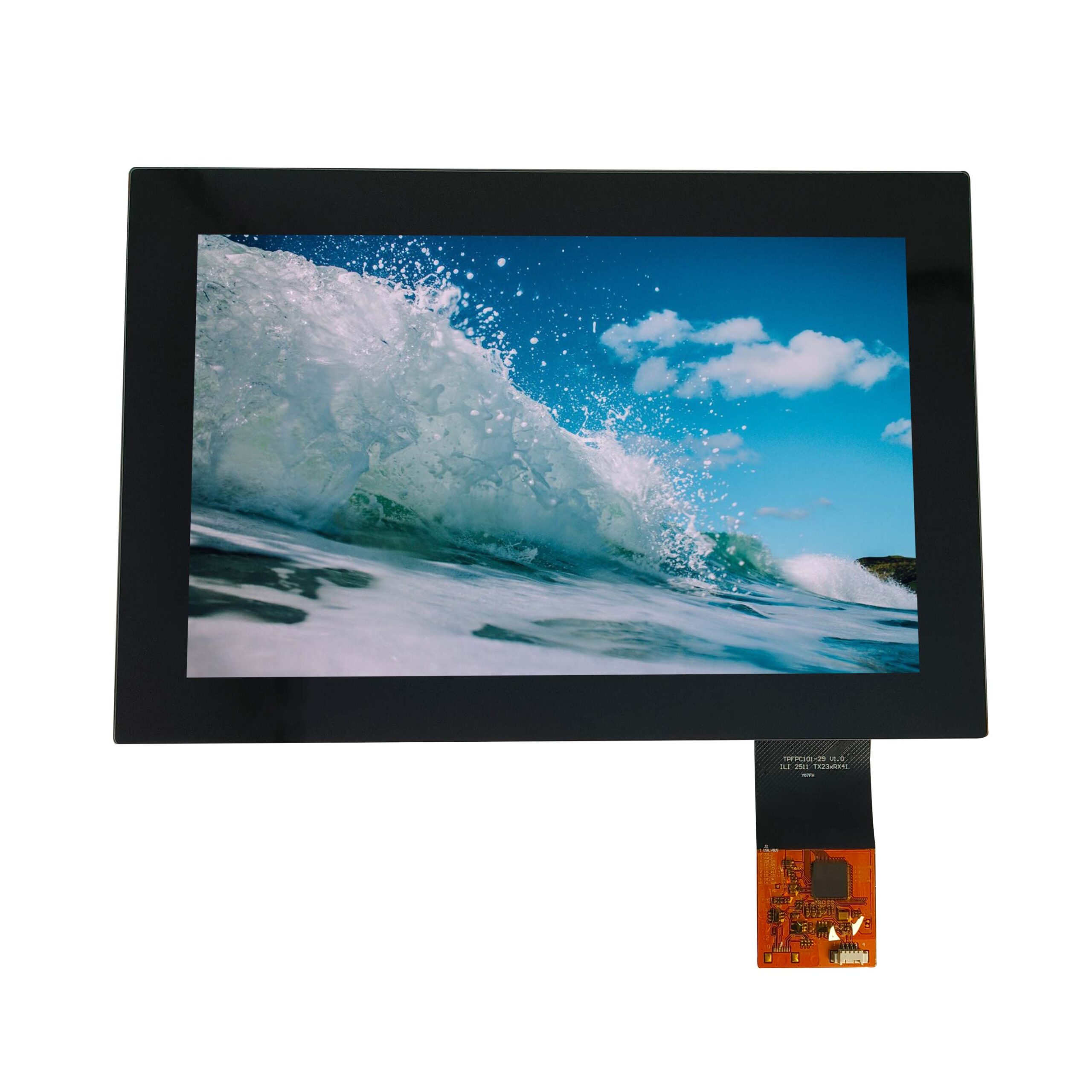
Stainless and coated bezels for hygiene zones
Hygiene design is about geometry before material.
Stainless steel bezels resist corrosion and cleaning chemicals, but the more important property in food environments is shape: no horizontal ledges, no exposed threads, no crevices where product can collect. A rounded, sloping bezel with a smooth transition to the enclosure cleans in seconds, while a flat-topped frame with visible fasteners becomes a cleaning task that operators skip.
Coated aluminium and painted steel are reasonable alternatives where the coating is specified for the cleaning chemistry; where the coating can chip, the substrate becomes a corrosion site. Specify the surface finish (for example, a defined roughness) as well as the material, because the finish determines both cleanability and light reflection.
Optical bonding in a washdown enclosure
Bonding solves moisture, and adds service implications.
A bonded stack removes the internal air volume, which eliminates the condensation surface that is the most common cause of internal fogging after a washdown cycle. It also improves contrast and reduces reflected light, both useful in a brightly lit plant. The trade is repair: a bonded front is normally replaced as a unit, so the spare part strategy must be at assembly level.
Where the enclosure is large and cooling is by conduction, bonding also improves the thermal path between the display and the front glass, though the glass is not usually the coldest surface in that case. The optical benefit is the primary reason to bond in food plants.
Temperature cycling with moisture present
Ingress usually happens during a temperature change, not a soak.
Warm air inside an enclosure holds more moisture than cold air, so when the surface cools rapidly the excess condenses. During a washdown the opposite happens: cold water cools the front, the internal pressure falls, and moisture is drawn in through any imperfect seal. Combined thermal and water testing therefore catches leaks that a static soak test misses.
Design countermeasures are a controlled vent path that equalises pressure without admitting liquid water, a desiccant where the enclosure volume is small, and avoiding designs where moisture can pool against a seal. Test with the production gasket after it has been compressed and cycled at least as many times as the service interval implies.
Failure modes that pass the certificate but fail in service
Certification is a snapshot; service is a sequence.
- Gasket compression set after repeated thermal cycles, reducing sealing pressure.
- Ink lift or colour fade on the printed border after chemical wiping.
- Adhesive edge lift from differential expansion in large bonded assemblies.
- Corrosion at fastener sites where dissimilar metals meet cleaning chemicals.
- Condensation behind the front glass after a rapid cool-down.
- Coating wear on the touch area, changing touch behaviour over time.
Each of these is predictable, and each should appear in the durability test plan rather than in a warranty claim.
A durability specification template for harsh-environment buyers
Write the specification as a sequence of exposures, not a list of ratings.
| Requirement | Specify | Verify by |
|---|---|---|
| Ingress | IP level, sealing method, gasket material and compression range | Assembly-level test after thermal cycling |
| Impact | IK level with the object and energy described | Impact test on the production front assembly |
| Chemical | Named cleaning agents, concentration and contact time | Repeated wipe and soak test on production materials |
| Thermal | Operating and washdown temperature extremes, cycle count | Combined thermal and water test |
| Optical | Haze, gloss and transmission limits after durability testing | Measurement before and after (ASTM D1003 for haze) |
| Service | Repair path and spare part level | Documented replacement procedure at the correct assembly level |
Environmental and static-control practice for the assembly is documented by bodies such as the EOS/ESD Association, and CDTech’s overview of what rugged really means is a useful sanity check on a claim before it reaches a drawing.
FAQ
What does IK10 mean for a display?
IK10 is the highest impact rating in the IEC scale, representing a substantial energy impact on the enclosure. It says nothing about the display’s optical surface, which may be a separate glass or plastic front with its own impact behaviour, and nothing about scratching or chemical resistance.
Which display survives washdown cleaning?
A display integrated into a front assembly with the sealing method, gasket material and surface treatment specified for the cleaning chemistry and jet direction. Survivability comes from the assembly and the materials, not from the panel. Look for repeated-cycle test evidence rather than a single-pass certificate.
Is IP69K necessary for food and beverage equipment?
It is common where high-pressure, high-temperature cleaning is used, because the test conditions match that practice. Where cleaning is a manual spray with lower temperature and pressure, a lower jet-rated level with the right gasket and chemicals may be sufficient and less costly to integrate.
Why does a sealed display fog up after a washdown?
Rapid cooling draws moist air in and condenses it on the coldest surface, usually the front glass or the air gap behind it. Bonding the display to the cover glass removes the condensation surface, and a controlled vent path equalises pressure without admitting liquid water.
Next step
Send the cleaning protocol, chemicals, jet conditions and impact risks to CDTech; the response will specify the front assembly materials, sealing method and test evidence rather than a rating alone.
Contact sales@cdtech-lcd.com or use the contact page; rugged and washdown classes are listed under industrial LCD displays.
Related articles
 Solar Inverter and Combiner Box Displays: Readability in Direct SunlightIndustrial & Specialist DisplaysTransparent, Reflective and High-Ambient Retail Displays: Where LCD Still WinsIndustrial & Specialist Displays
 Passenger Information Displays for Buses and Trains: Standards, Readability and ReliabilityIndustrial & Specialist Displays
 Long Display Cables in Industrial Machines: Signal Integrity Without an Expensive RedesignIndustrial & Specialist Displays