Human-Machine Interface Displays for Food and Beverage Lines: Hygiene, Washdown and Uptime
HMI displays for food and beverage lines: hygiene geometry, washdown and caustic cleaning, wet-glove touch, scratch resistance and hot-swap service design.
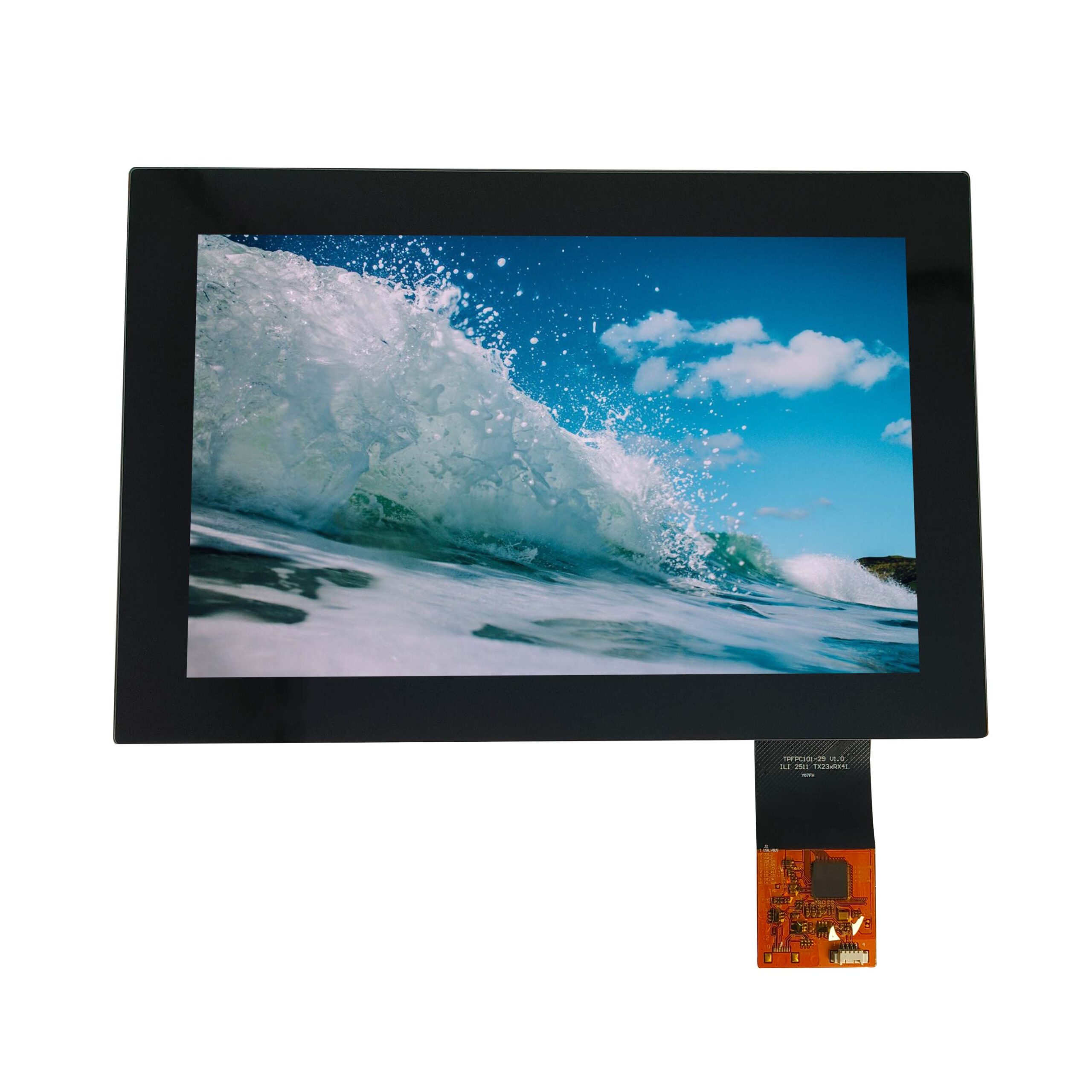
On a food line the display is judged by two things the datasheet does not measure: whether a hygiene inspector can see a place where product collects, and whether a washdown stops production long enough to matter. Both are design decisions made before the panel is chosen, and both are cheaper to solve in the front assembly than in the factory.
Part of the Industrial LCD Displays guide — 40 articles on continuous duty, sealing and long service life outside the cabin.
Hygiene design rules that a display must respect
No ledges, no crevices, no horizontal surfaces.
Hygienic design guidance for food equipment converges on a few principles: surfaces that drain, joints that are sealed rather than lapped, fasteners that are hidden or sealed, and materials that withstand the cleaning regime. A display bolted through a flat frame with exposed screw heads and a recessed gasket groove violates all four. A sloped bezel with a continuous bond to the glass, no exposed fasteners and a smooth transition to the panel satisfies them.
The practical test is to look at the assembly the way a cleaning operative does: is there anywhere a cloth cannot reach in one motion, and anywhere liquid can stand? If the answer is yes, the design will be cleaned less thoroughly than the standard requires.
IP69K, washdown and caustic cleaning agents
Match the sealing test to the cleaning method, then add chemistry.
High-pressure, high-temperature washdown corresponds to the IP69K level in the IP code family, which is defined by a specific jet test rather than by a general statement of toughness. Caustic and acidic cleaning agents then add a chemistry requirement that ingress testing does not cover: the gasket, sealant, print and bezel coating must be compatible with the actual agent at the actual concentration and contact time.
Request the compatibility data and validate it with a repeated cycle test – jet, dwell with chemical, rinse, cool – because the failure mode is cumulative. CDTech’s guidance on hygiene, disinfection and chemical resistance applies the same logic in clinical environments, where cleaning is equally aggressive.
Capacitive touch with wet and gloved hands on a production line
Wet gloves are the hardest case for any touch technology.
Operators on a food line wear gloves, often wet, and may touch the screen with a forearm when both hands are occupied. Capacitive sensors respond to water films as if they were touches, which produces phantom activity; resistive panels are pressure-based and tolerate water and gloves but add a mechanical layer that food environments do not always favour. The workable middle ground is a capacitive panel with a tuned water-rejection profile, a hydrophobic surface, and physical buttons for the functions used most often with wet hands.
Validate with the customer’s gloves and a wet-glove test at the actual glass thickness. CDTech’s notes on gloved hands and rain describe what tuning can and cannot deliver.
Scratch resistance on a shop floor that never stops
Hardness matters because surfaces are wiped hundreds of times a day.
Repeated wiping with abrasive cloths and cleaning pads degrades a soft surface quickly, producing a haze that reduces contrast and, on touch panels, changes the feel of the surface. Chemically strengthened glass is the standard answer for the touch area, with a hard coating where the cleaning regime is unusually aggressive. Polycarbonate fronts are more impact-tolerant but scratch far more easily, so they suit areas where impacts dominate and abrasive cleaning does not.
Specify surface hardness and the cleaning method together, and test abrasion on the production front assembly. Haze measurement (ASTM D1003) before and after the abrasion cycle gives a comparable number.
Mounting that avoids water traps and bacterial harbourage
Mounting geometry decides cleanability as much as material.
A display mounted proud of a panel with a gap behind it creates a place for product and water to collect; a display mounted flush with a sealed rear volume can be cleaned in one motion. Where a rear enclosure is unavoidable, it should be sealed, smooth and positioned so that liquid drains rather than pools. Cable entries should be sealed and, where possible, on the underside or the rear, away from spray.
Fasteners should be concealed or sealed, and any adjustment mechanism should be internal. The most common inspection finding is not a material failure but a design that requires a tool to clean.
Temperature swings between washdown and oven zones
Rapid cooling after a hot process is the stress case.
A display near an oven or a fryer, then hit with cold washdown water, sees a rapid thermal gradient that stresses the seal, the bonded layers and the electronics at the same time. The design responses are a gasket or bond qualified across the full range rather than at room temperature, a controlled vent path to equalise pressure without admitting water, and a bonded stack to remove the internal air volume where condensation would form.
Test the sequence, not the extremes: hot soak, cold jet, dwell, repeat. That cycle reproduces the field failure that a static immersion test misses.
Readability under bright overhead lighting
Overhead light is directional and produces specular glare.
Food plants are brightly lit with luminaires directly above the line, which is precisely the geometry that produces a sharp reflection on a glossy screen. An anti-glare front spreads the reflection and an anti-reflective coating reduces it, and the combined treatment is normal for this environment. Where the display is viewed by operators wearing hairnets and glasses, specular glare is also a safety consideration.
Specify the readability requirement by measuring at the installed position with the lighting in operation, and check the reflection with the operator’s eye position rather than from directly in front. CDTech’s material on brightness and sunlight readability by design covers the same optical chain.
Stainless steel frames and food-safe materials
Material selection follows the cleaning chemistry and the inspection regime.
Stainless steel is the default for frames and housings in hygiene zones because it resists caustic cleaning and does not chip. Where a coating is used instead, the coating must be specified for the cleaning agents and for mechanical contact, because a chipped coating becomes both a corrosion site and a foreign-body risk. Plastics used near food should be specified for the cleaning chemistry and for temperature, and their surface finish should be smooth enough to clean.
Document the materials in the front assembly with their cleaning compatibility, and keep that record with the machine documentation; it is what an audit will ask for.
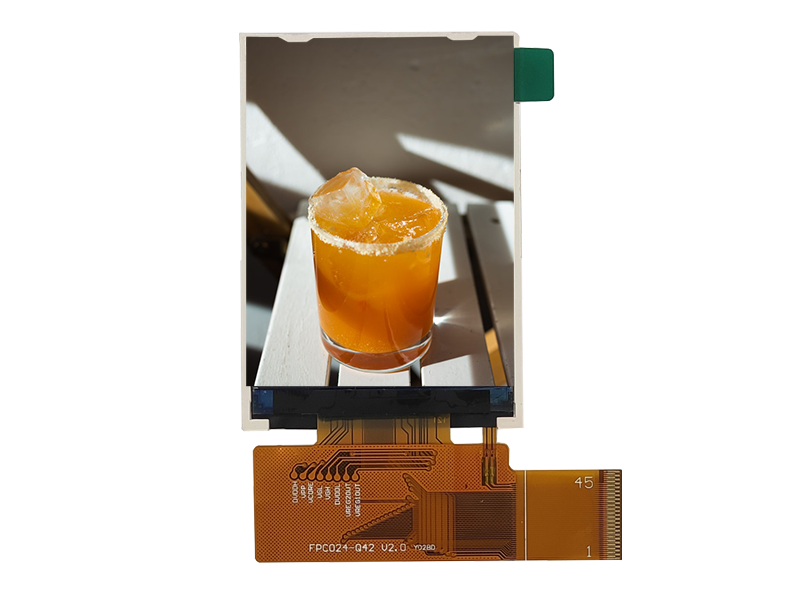
Reducing downtime: hot-swap and service design
Minutes of service time are the real specification.
When a display fails mid-shift, the cost is the line stoppage, not the part. Designs that reduce downtime have accessible connectors, a front assembly that can be replaced without dismantling the machine, and firmware or calibration data that can be transferred without specialist tools. Where the front is bonded, the spare part should be the whole bonded front assembly, pre-assembled and tested, so the swap is mechanical.
Stocking one spare front assembly per line is usually cheaper than the downtime avoided in a single event. Quantify the stoppage cost per hour and the specification writes itself.
Validation evidence buyers should request from a supplier
Ask for the test record, not the certificate.
- Ingress test report on the assembled front panel, with the sealing method and gasket compression stated.
- Repeated washdown and chemical cycle test with the agents and concentrations used in service.
- Thermal cycling report including the hot-to-cold jet sequence.
- Abrasion and haze measurement before and after cleaning cycles.
- Touch validation with wet gloves at the specified glass thickness.
- Materials list with cleaning compatibility for gasket, sealant, print and bezel.
Environmental and static-control practice for the assembly is documented by bodies such as the EOS/ESD Association, and CDTech’s industrial display range provides a starting point for the panel classes used in these lines.
FAQ
What IP rating does a food factory display need?
It should match the cleaning method: high-pressure, high-temperature cleaning corresponds to the IP69K level, while a manual spray may be satisfied by a lower jet-rated level. The rating must be achieved by the assembled front panel, and the cleaning chemicals must be compatible with the gasket, sealant and print.
Can touchscreens be cleaned with chemicals daily?
Yes, if the surface treatment and adhesives are specified for the chemicals and the contact time. Failures usually appear in the printed layers, the gasket and the coating rather than the glass itself, so compatibility data should be requested for each material in the front assembly.
How do we stop a washdown display from fogging internally?
Remove the internal air volume by bonding the display to the cover glass, and equalise pressure with a controlled vent path that does not admit liquid water. Rapid cooling after a hot process is the driving condition, so test the hot-soak and cold-jet sequence rather than a static soak.
What reduces HMI downtime on a food line most effectively?
A pre-assembled, pre-tested spare front assembly with accessible connectors, so replacement is mechanical and takes minutes. Quantify the cost of a line stoppage per hour; in most plants it justifies holding a spare assembly per line rather than per site.
Next step
Send the cleaning protocol, chemicals, glove conditions and downtime cost to CDTech and the proposal will specify the front assembly materials, sealing method and service strategy for the line.
Contact sales@cdtech-lcd.com or use the contact page.
Related articles
 Solar Inverter and Combiner Box Displays: Readability in Direct SunlightIndustrial & Specialist DisplaysTransparent, Reflective and High-Ambient Retail Displays: Where LCD Still WinsIndustrial & Specialist Displays
 Passenger Information Displays for Buses and Trains: Standards, Readability and ReliabilityIndustrial & Specialist Displays
 Long Display Cables in Industrial Machines: Signal Integrity Without an Expensive RedesignIndustrial & Specialist Displays