Medical Touch Displays: Gloves, Disinfectants and the Physics of Both
Medical touch displays: what nitrile and double gloves do to a capacitive sensor, disinfectant films and false touches, glass thickness and coating wear.
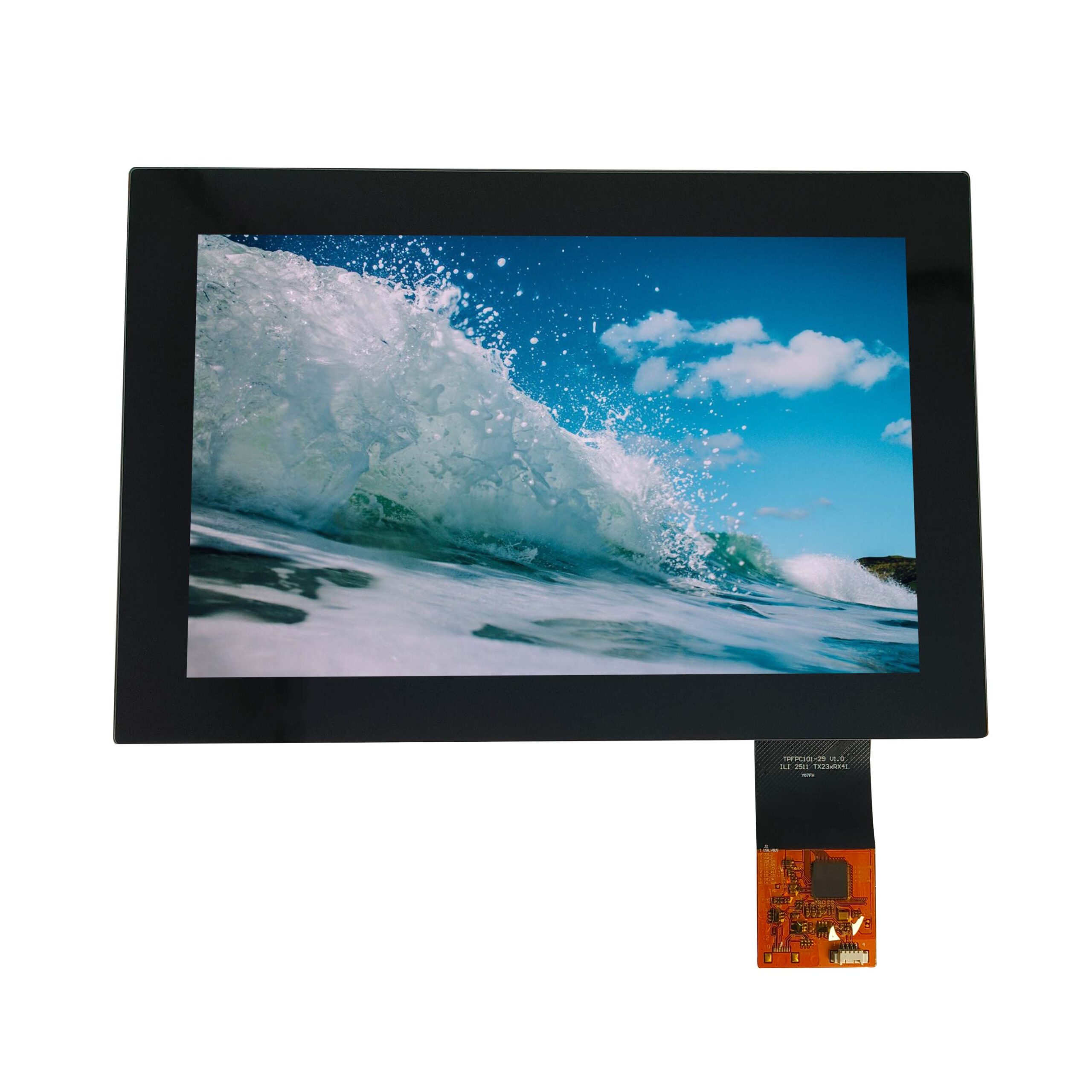
Two complaints dominate medical touch interfaces: it does not work with gloves, and it registers touches that nobody made. Both are consequences of the sensor measuring a very small change in capacitance through whatever is on the glass – a glove, a disinfectant film, a drape or a drop of fluid. Understanding what each layer does to that measurement is what makes the tuning decision predictable instead of experimental.
Part of the Medical & Clinical Displays guide — 19 articles on DICOM, IEC 60601-1, hygiene and patient monitoring.
Nitrile gloves, latex and double-gloving: what the sensor sees
A glove is a dielectric spacer between finger and sensor.
The sensor does not detect the finger, it detects the change in coupling caused by a conductive object approaching the electrodes. A glove increases the distance between the finger and the electrodes and adds a layer with its own permittivity, both of which reduce the measured change. Nitrile and latex examination gloves are thin enough that this reduction is usually recoverable with gain and threshold tuning; two layers, or a glove worn over a thicker glove, can push the change below the noise floor.
Glove fit matters as much as material: a loose glove leaves an air gap that behaves like an extra dielectric layer, while a snug glove keeps the finger closer to the surface. That is why two hospitals using nominally the same glove can report different results.
Capacitive vs resistive for clinical workflows
Resistive wins on gloves; capacitive wins on optics and gestures.
A resistive touch panel responds to pressure, so it works with any glove, with a drape, and with a stylus, at the cost of lower transmission, a softer surface and no multi-touch. A capacitive panel gives better clarity, a harder surface and gesture support, but its performance depends on what is between the finger and the glass. In clinical workflows the deciding factors are the glove type, whether a drape covers the screen, and whether the device is operated while the clinician is also holding something else.
CDTech manufactures both technologies, which allows the choice to be made on workflow rather than on availability. The comparison is set out in CDTech’s PCAP versus resistive comparison.
Thin vs thick gloves and the tuning window
Tuning has a limit, and thick gloves exceed it.
Increasing gain and lowering the detection threshold extends glove compatibility, but both moves also reduce the margin against noise and against false touches from fluids on the surface. There is a point at which the settings required for thick gloves make the panel unreliable in normal use, and that point should be established empirically rather than discovered in a clinical complaint.
A useful test matrix is glove type against fluid presence against brightness setting, run on the production stack. The output identifies the settings that work across the matrix, and the settings that require a design change such as thinner glass or a different sensor pattern. CDTech’s material on gloved hands and wet surfaces describes the tuning techniques and their limits.
Disinfectant films, wet surfaces and false touches
A wet film couples electrodes together and looks like a large touch.
Alcohol-based disinfectants evaporate quickly, but quaternary ammonium compounds and chlorine-releasing solutions leave a film that can persist. The controller interprets the resulting coupling change as a large, slow-moving contact and either registers a phantom touch or rejects the frame entirely. The mitigations are a hydrophobic surface treatment so the liquid beads rather than spreads, electrode geometry that avoids large continuous areas near the edges, and firmware that rejects slow, large, low-confidence patterns.
Residue also changes friction, which affects the perceived quality of the surface. Validate with the actual agent and the actual drying time rather than with water.
Cover glass thickness and optical bonding trade-offs
Thicker glass for durability costs signal margin.
Increasing cover glass thickness improves impact resistance and often the perceived quality of the device, but it increases the distance between the finger and the sensor, which reduces the measured change. Optical bonding removes the air gap and makes the dielectric stack more consistent, which partially offsets the loss, and it also improves contrast and eliminates the surface where cleaning fluid collects. The practical sequence is to set the thickness from the durability and cleaning requirement, then size the sensor and controller to match, then confirm with a grid test.
The design variables in the front assembly – glass thickness, coatings, print and bonding – are covered in CDTech’s cover glass design notes.
Touch response with screen protectors and drapes
Anything added to the front is part of the dielectric stack.
Protective films, adhesive screen protectors and sterile drapes all add layers with their own thickness and permittivity. A thin, well-adhered film usually has a manageable effect; a thick drape can reduce coupling enough that a capacitive panel becomes unusable, which is why draped equipment normally uses physical controls or indirect input. Where the customer intends to use a protector, specify it as part of the stack and validate with it in place.
A related issue is air between layers: a loosely applied protector creates an air gap that behaves unpredictably across the surface, producing areas that respond differently.

Cleaning cycles and surface wear over years
Touch surfaces degrade from cleaning, not from touching.
Repeated wiping with disinfectant and abrasive cloths wears the anti-fingerprint coating and can slowly change the surface energy of the glass, which changes both friction and how liquid films behave. The measurable consequence is a haze increase and, at the extreme, a change in touch behaviour near the most-used areas. Specify the number of cleaning cycles in the durability test and measure haze before and after, using a defined method rather than visual inspection.
Where the surface coating is essential to the application, treat it as a wear item with a defined life and, where practical, a replaceable outer layer.
Chemical resistance of coatings and adhesives
The glass is the least vulnerable material in the stack.
The print, the coating and the adhesive edge are the materials that fail first under repeated chemical exposure. The relevant data is compatibility for each material with each named agent at the concentration and contact time used, and the relevant test is repeated cycles on the production front assembly. Adhesive suppliers publish this material data, and CDTech’s guidance on medical touch hygiene and chemical resistance describes how to apply it.
Where the agent list is not yet known, specify the expected chemistry rather than leaving it blank, because a design that works for alcohol wipes may fail with chlorine-releasing agents.
Validating glove performance with a repeatable test
Make the test a number, not an opinion.
- Define the gloves to be tested: brand, material, thickness and fit.
- Define the grid of touch points across the screen, including the outer 10 mm.
- Define the contact method: finger pressure, contact time and angle.
- Record the pass rate per point with the production firmware settings.
- Repeat with the surface wetted with the named agent.
- Repeat at the lowest and highest brightness settings.
This produces a document that a hospital can review and a design team can act on, and it takes a day per configuration. CDTech’s material on medical display cleaning and cover glass covers the practical side of the same procedure.
Selection matrix for ICU, ward and outpatient use
Score the environment, not the technology.
| Setting | Typical glove regime | Recommended technology | Notes |
|---|---|---|---|
| ICU bedside | Examination gloves, occasional double-gloving | Capacitive with glove tuning; physical controls for therapy parameters | Dim environment; flicker-free dimming matters |
| Ward | Examination gloves, bare hands | Capacitive with anti-fingerprint coating | Frequent cleaning, high wipe count |
| Operating theatre | Sterile gloves, drapes, fluids | Indirect input preferred; resistive where direct touch is required | Drape compatibility must be tested |
| Outpatient and lab | Bare hands, occasional nitrile | Capacitive, thinner cover glass | Chemical exposure from bench work |
Coating and abrasion behaviour of the chosen front is measured with haze and gloss methods, for which ASTM D1003 is the usual reference, and static-discharge considerations for the front surface are covered by material from the EOS/ESD Association.
FAQ
Why do hospital touchscreens not work with gloves?
A glove separates the finger from the sensor and reduces the measured capacitive change. Thin nitrile or latex gloves are usually recoverable through tuning, while thick or double gloves may reduce the signal below the noise floor. In that case the practical answers are thinner cover glass, a different sensor pattern or physical controls.
Which touch technology is best for medical devices?
Capacitive touch suits most clinical settings because of clarity, durability and gesture support, provided the glove regime is validated. Resistive touch remains appropriate where thick gloves, drapes or a stylus are used, or where fluid on the surface is unavoidable.
Why does a touchscreen register touches when it is wet?
A liquid film couples sensor electrodes together, producing a signal that resembles a large, slow touch. Hydrophobic treatment, electrode geometry and firmware rejection of low-confidence patterns reduce the effect, and the response should be validated with the specific disinfectant rather than with water.
Does a screen protector affect medical touch performance?
It adds a layer to the dielectric stack, so yes, though a thin well-adhered film is usually manageable. A loosely applied protector traps air and creates uneven response across the screen. Where a protector is intended, specify it as part of the stack and validate with it fitted.
Next step
Send the glove types, cleaning agents and cover glass requirement to CDTech; the reply will state the achievable tuning window, the recommended sensor and bonding configuration, and the test method to validate it.
Contact sales@cdtech-lcd.com or use the contact page.
Related articles
 Dental, Ophthalmic and Aesthetic Device Displays: Colour and Detail Under MagnificationMedical & Clinical Displays
 Point-of-Care and Diagnostic Device Displays: Small Screens With Big RequirementsMedical & Clinical DisplaysSurgical and Operating Room Displays: Image Quality, Latency and HygieneMedical & Clinical DisplaysPatient Monitor Displays: Specs, Interfaces and Certification RequirementsMedical & Clinical Displays