Medical Display Compliance: A Practical Map of IEC 60601-1, ISO 13485 and MDR
Differentiation page: publish the linked new page before the foundation rewrite of the old page. | Meta description: Medical display compliance: who owns IEC 60601-1, what ISO 13485 at a display factory covers, MDR…
Most medical display compliance problems are ownership problems. A factory certificate is quoted as if it covered the device; a test report is offered as if it covered a different module; a supplier is asked to declare conformity to a standard that only the device manufacturer can declare. This article maps who owns which obligation, what evidence transfers between parties, and what a display supplier can and cannot provide.
Part of the Medical & Clinical Displays guide — 19 articles on DICOM, IEC 60601-1, hygiene and patient monitoring.
Who is responsible for what: OEM, integrator and display supplier
The device manufacturer owns the compliance claim, always.
IEC 60601-1 applies to medical electrical equipment as a system, which means the device manufacturer is responsible for the declaration, the risk management file and the technical documentation, regardless of how many component suppliers contribute. A display module manufacturer supplies a component with defined characteristics and evidence about those characteristics; it does not, and cannot, declare that the finished device complies.
What the display supplier owns is narrower and more useful: the specification of the component, the consistency of production against that specification, the traceability of the materials that affect safety-relevant behaviour, and notification when any of that changes. Buyers who frame the conversation in those terms get usable answers; buyers who ask for a 60601-1 certificate from a panel factory get a document that does not mean what they think it means.
IEC 60601-1 clauses that touch the display and its power
The display contributes to leakage current, temperature and enclosure requirements.
In a medical device, the display sits inside the electrical safety architecture: it consumes power, contributes to leakage current through its own capacitance and supply, produces heat at the surface the patient or clinician may touch, and forms part of the enclosure. The tests that most often involve the display are leakage current, surface temperature, dielectric strength and mechanical strength of the enclosure. The standard itself is published by IEC and can be purchased as IEC 60601-1.
The practical consequence is that the display specification must state supply voltage and current, insulation class, surface temperature at maximum brightness in the intended enclosure, and the mechanical construction of the front. These are the numbers the device’s test house will ask for, and they are cheapest to obtain from the display supplier as a documented component specification rather than measured on the finished device.
IEC 60601-1-2 EMC: why displays fail susceptibility tests
The display is often the most susceptible subsystem in the device.
Medical EMC requirements include both emissions and immunity, with immunity levels that are higher than in many other equipment categories. Displays fail susceptibility in characteristic ways: video sparkle or dropout during radiated immunity sweeps, touch faults during conducted immunity, and reset or flicker during fast transients on the supply. The causes are the long unshielded conductors in the display cable, the sensitive capacitive touch front end and the switching backlight driver.
Mitigation begins at the component level: a display with a differential interface, a defined grounding arrangement and documented immunity behaviour gives the device designer somewhere to start. Ask the display supplier which tests were run, at what levels, and with which configuration, because a report without the configuration cannot be applied to a different host.
What ISO 13485 at a display factory does and does not cover
It covers the quality system, not the device approval.
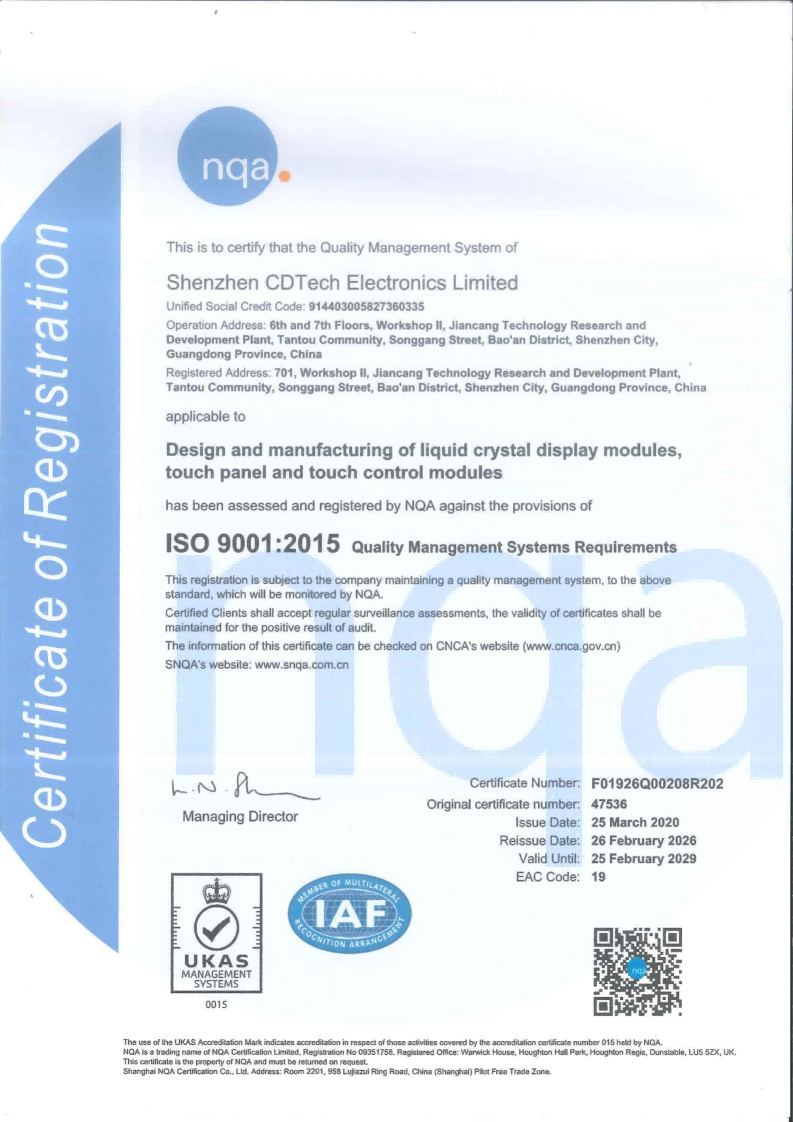
ISO 13485 is a quality management system standard for organisations supplying medical devices and their components. A display factory certified to ISO 13485 has a documented system for design control, production control, traceability, corrective action and supplier management as it applies to its own products. CDTech lists ISO 13485 with a validity period of 26 Mar 2026 to 25 Mar 2029 alongside ISO 9001, ISO 14001 and IATF 16949.
What the certificate does not do is approve any device, cover the customer’s design, or guarantee a specific test result. It is evidence that the factory’s processes are controlled, which is a prerequisite the customer’s own audit programme can build on. Verify the certificate against the issuing body and confirm that the product line being purchased is inside its scope, because scope statements are frequently narrower than the certificate’s title suggests.
EU MDR: technical documentation and supplier evidence
The manufacturer’s technical file needs component evidence, not component certificates.
Under the EU medical device regulation, the manufacturer compiles technical documentation and maintains a risk management process, and the notified body examines that file rather than the supply chain directly. What the file needs from a display supplier is component-level evidence: specifications, material declarations, test reports relevant to the risk analysis, change notification commitments and traceability data. The European Commission’s medical devices sector pages describe the regulatory framework that determines what a manufacturer must hold.
The practical item that most often causes delay is a material declaration: whether the front assembly contains substances of concern, and whether the supplier can commit to notifying changes in those materials. Ask for it early, because it takes time to obtain from sub-suppliers and it is not something a final assembly stage can generate retrospectively.
US FDA 510(k) context for displays used in devices
Displays are components in a cleared device, not separately cleared devices.
For devices marketed in the United States, the display is typically part of a device that obtains clearance or approval through the applicable pathway, and the manufacturer’s submission describes the device as a system. The display’s contribution is to the device’s performance and safety claims: its image quality, its response time, its alarms and its labelling. Where a display change affects those claims, it falls inside the manufacturer’s change-control process.
Consequently, the display supplier’s most valuable contribution is predictability: staying within a frozen specification, notifying changes in advance, and providing the verification data that supports an unchanged claim. Standards work relevant to medical device quality and test practice is maintained through bodies such as AAMI.
Biocompatibility and patient-contact boundaries
Most displays are not patient-contacting, and the specification should say so.
Biocompatibility requirements apply to materials that contact the patient or that contact clinical surfaces with a plausible path to the patient. A display in a monitor housing usually touches only the clinician, which keeps it outside patient-contact requirements – but a front surface on an intracavity device or a device used in a sterile field is a different case. State the contact classification explicitly in the display requirement, and require the supplier to confirm the materials used in the front assembly, because the classification changes what evidence is needed.
Where cleaning rather than contact is the issue, the material data needed is chemical compatibility, which is documented in the same front-assembly material list.
Essential performance and what the display must keep doing
Essential performance defines what must survive an abnormal condition.
Medical devices define essential performance as the performance needed to avoid unacceptable risk, and the display participates in it when it conveys alarms, waveforms or therapeutic parameters. The specification question is therefore what the display must continue to show during a fault or disturbance: a frozen image is a failure, a loss of backlight is a failure, and a brightness change that hides an alarm is a failure. Documenting the expected behaviour during loss of signal, link retraining or a power dip makes the display’s contribution to essential performance explicit.
For displays used in applications such as electrocardiography, additional device-specific requirements exist; the relevant standard family is illustrated by publications such as IEC 60601-2-10, which covers particular requirements for nerve and muscle stimulators.
Documentation package to request from a display supplier
Ask for the component evidence set, not the certificates.
| Item | What it should contain |
|---|---|
| Product specification | Electrical, optical, mechanical and environmental limits, with test conditions |
| Front assembly materials | Glass, adhesive, gasket, print and coating, with cleaning compatibility |
| Safety-relevant data | Supply current, insulation arrangement, surface temperature at maximum brightness |
| EMC behaviour | Test configuration and observed behaviour during immunity tests |
| Reliability data | Thermal, vibration, humidity and lifetime results at stated conditions |
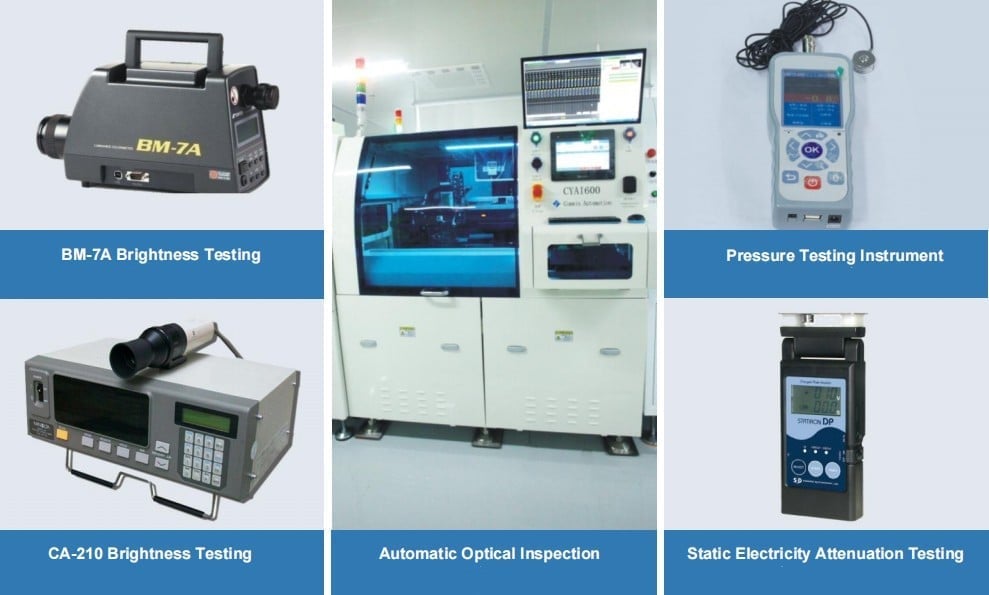
| Quality system evidence | ISO 13485 and ISO 9001 certificates with scope and validity; internal inspection chain |
| Traceability | Lot and material traceability example, reconstructable from records |
| Change control | Notification commitment, including material and process changes |
The structure of a controlled medical display programme, including how these documents are maintained across revisions, is described in CDTech’s notes on how an ISO 13485 medical display programme works.
Common compliance gaps found in display supply chains
The gaps are predictable and cheap to close early.
- Certificate scope that excludes the site or product line actually being purchased.
- Test reports without the configuration, so the result cannot be applied to a different host.
- No material declaration for the front assembly, delaying the technical file.
- Change notification described as a courtesy rather than a contractual requirement.
- Traceability that stops at the shipping carton rather than at the material lot.
- Performance claims measured in conditions unrelated to the clinical environment.
Each of these is a documentation gap rather than a technology gap, and each is closed by specifying the evidence in the purchase agreement rather than by auditing harder afterwards.
FAQ
Does a display supplier need ISO 13485?
Not always, but it is the usual expectation for components supplied into a medical device, because the manufacturer’s own audit and documentation obligations are easier to satisfy with a supplier that operates a recognised quality system. Confirm that the scope of the certificate covers the site and the product line being purchased.
What certifications does a medical display need?
The display itself is a component, so it does not hold a device certification. Requirements such as IEC 60601-1 and IEC 60601-1-2 apply to the finished device, and the display contributes to the relevant tests through its electrical, thermal and EMC behaviour. The supplier’s role is to document that behaviour accurately.
Does an ISO 13485 certificate at a display factory cover the finished device?
No. It demonstrates that the factory’s quality system is controlled for its own products. Device approval, risk management and technical documentation remain with the device manufacturer, who uses the component evidence as an input.
How early should compliance evidence be requested from a display supplier?
At the specification stage, before design freeze. Material declarations, scope-limited certificates and EMC behaviour data all take time to obtain, and a gap discovered during submission or during a notified body review is far more expensive than one found in the first design review.
Next step
Send the device classification, intended contact surface and the applicable standards to CDTech; the response will list the component evidence available for the specific display module and flag anything that must come from another supplier.
Contact sales@cdtech-lcd.com or use the contact page; the certificate scope is published on the quality certifications page.
Related articles
 Dental, Ophthalmic and Aesthetic Device Displays: Colour and Detail Under MagnificationMedical & Clinical Displays
 Point-of-Care and Diagnostic Device Displays: Small Screens With Big RequirementsMedical & Clinical Displays
 Medical Touch Displays: Gloves, Disinfectants and the Physics of BothMedical & Clinical DisplaysSurgical and Operating Room Displays: Image Quality, Latency and HygieneMedical & Clinical Displays