Screen Yellowing and Panel Ageing
Screen yellowing and panel ageing: how polarisers, adhesives and backlights yellow over time, how to measure the shift and how to specify against it. | Target URL: https://blog.cdtech-lcd.com/screen-yellowing-panel-ageing/

Yellowing is the slowest display defect and the easiest to miss, because it develops over years and both the customer and the supplier adapt to it. By the time it is raised, the panels are out of warranty and the cause – polariser, adhesive or backlight – is hard to separate. Measuring the shift early and specifying a limit is the only practical defence.
Part of the Quality, Testing & Compliance guide — 33 articles on defect classes, inspection, qualification and certification.
What yellowing looks like, and where it starts
A gradual shift towards yellow, usually from an edge or a corner.
Age-related yellowing typically appears first at the edges, where moisture and oxygen reach the polariser and adhesive first, and spreads inward; a uniform shift across the whole panel usually points at the backlight or the drive current rather than the polariser. A localised yellow spot with a defined boundary is more likely a contamination or a bonding defect than ageing. Photographing the panel on a white field at commissioning gives a baseline that makes the later comparison possible.
Because users adapt to a slow shift, the complaint usually arrives as “the new unit looks different” rather than as “this screen is yellow”.
Polariser ageing
Heat and ultraviolet light degrade the polymer.
The polariser is a stretched polymer film with an iodine or dye layer, laminated to the glass with an adhesive. Heat, ultraviolet light and humidity progressively change the dye and the adhesive, producing a yellow shift and often a loss of contrast at the same time. Panels used outdoors or in hot enclosures age fastest, and the failure is permanent because the material has changed. CDTech’s notes on marine display construction illustrate how environmental exposure drives material selection.
Material grades matter here more than panel brand: two suppliers using the same panel but different polariser grades will age differently.
Adhesive and bonding ageing
The optical adhesive is the second polymer in the stack.
The adhesive that bonds the display to the cover glass can also shift with heat and ultraviolet exposure, and it can yellow unevenly where exposure differs across the panel – for example near an edge that receives more sun. A bonding-related shift often appears as a gradient rather than an edge creep. Its rate depends on the adhesive chemistry, which is one reason a change of adhesive supplier without notification is a serious quality event.
Adhesive and coating data from suppliers such as Henkel and DELO is the practical way to compare candidates for a long-life product.
Backlight effects that look like yellowing
Aged LEDs shift as well as dim.
White LEDs change colour as they age, and the change depends on drive current and junction temperature, so a display run hot and bright shifts faster than one run cool and dim. Because the shift is uniform across the backlight, the symptom is a panel-wide yellow or blue cast rather than an edge effect. CDTech’s notes on LED binning and brightness matching describe how initial variation and ageing interact.
Derating brightness and improving the thermal path therefore slow colour ageing as well as extending backlight life.
How to measure the shift
Use the same measurement at commissioning and after cycling.
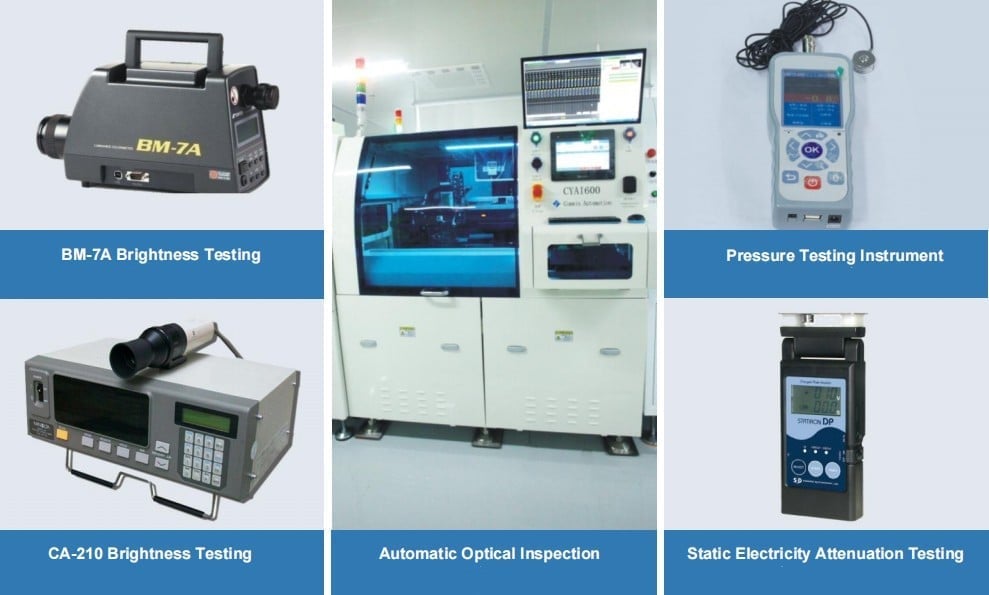
A spectroradiometer or colorimeter on a white field gives the chromaticity coordinates, and the difference between two sets of coordinates is a quantifiable shift. Measuring at several points distinguishes an edge creep from a uniform change, and measuring at the same warm-up condition makes the comparison valid. Colour and appearance definitions are published through the CIE, and instrument procedures by vendors such as X-Rite.
A photograph from a fixed position at fixed exposure is a useful secondary record, but only the measurement settles a dispute.
Accelerated ageing tests
Combine heat, ultraviolet light and time.
A useful accelerated test exposes production-intent front assemblies to ultraviolet light at a defined irradiance while cycling temperature, then measures colour and haze before and after. Running at two stress levels makes the extrapolation defensible rather than a single-point estimate. The test belongs on the finished assembly, because the adhesive and coating are usually the parts that change.
Third-party test scopes are published by laboratories such as Intertek, and glass substrate properties by suppliers such as AGC.
Specifying against yellowing
State the limit, the condition and the age.
A specification can require that the colour difference at a stated point after a defined accelerated exposure stays below a limit, and that the difference across the panel stays within a second limit. Naming the polariser and adhesive grades closes the substitution route that would otherwise make the requirement unenforceable, and the change notification agreement should cover both materials explicitly.
Where a product is expected to last a decade outdoors, the ageing allowance belongs in the original colour specification rather than in a warranty discussion later.
Incoming inspection and drift tracking
Record coordinates, not impressions.
Receiving inspection should record chromaticity on a white field for each lot, in the same conditions, so that a drift across lots is visible before it becomes visible to customers. Where several production periods are in service, a comparison between them often shows the ageing rate, which is useful when setting a recalibration or replacement interval.
Panel and technology trends that affect material choices are reported by research firms such as TrendForce and LEDinside, and CDTech’s measurement practice is described in measuring brightness, contrast and uniformity.
When yellowing is a defect and when it is normal ageing
The specification decides, not the appearance.
Every display shifts colour slightly over its life; what matters is whether the shift exceeds the limit the product was specified against, and whether it happened faster than the qualification predicted. A panel that yellows within the declared allowance is behaving normally, while one that exceeds it after a fraction of the expected life points at a material or thermal problem – and the measurement record is what distinguishes the two.
Keeping the commissioning measurement, the qualification data and the incoming lot records together is what makes that judgement possible. Related material is collected at the display and touch solutions centre.
FAQ
Why is my LCD screen yellowish?
The most common cause in an aged panel is polariser degradation, which starts at the edges where moisture and oxygen reach the film first. A uniform cast across the whole panel usually points at the backlight or its drive conditions rather than the polariser.
Can screen yellowing be fixed?
No. Yellowing is a permanent material change in the polariser, the adhesive or the backlight LEDs, and it cannot be reversed or corrected in software without shifting other colours. The practical options are to accept it within the declared tolerance or replace the front assembly.
How can yellowing be prevented?
By specifying polariser and adhesive grades rated for the exposure the product will see, keeping the backlight drive current and internal temperature low, and requiring notification before either material changes. Ageing is slowed rather than eliminated; the specification sets the acceptable rate.
How is yellowing measured?
With a spectroradiometer or colorimeter on a white field, recording chromaticity at defined points after a fixed warm-up, and comparing the values before and after an accelerated ageing test. Photographs support the record but do not replace the measurement.
Next step
Send the service life, the exposure conditions and the panel’s commissioning colour data to CDTech; the reply will state the achievable colour stability and the material grades behind it.
Contact sales@cdtech-lcd.com or use the contact page.
Related articles
 Second-Source Qualification for Display Modules Without Doubling Your Inventory RiskQuality, Testing & ComplianceIncoming Inspection for Display Modules: What to Check and How OftenQuality, Testing & ComplianceEMC Certification for Display Products: Passing the First TimeQuality, Testing & Compliance
 Screen Damage Modes: Distinguishing Production Defects From Field DamageQuality, Testing & Compliance