Which Display Certifications Actually Matter for Your Market
Differentiation page: publish the linked new page before the foundation rewrite of the old page. | Meta description: Which display certifications matter: component versus finished-product compliance, CE and UKCA, RoHS and REACH, EMC and…
Certification questions usually start from the wrong end: buyers ask which certificates a supplier holds, when the real question is which approvals the finished product needs in each market, and what evidence the display must contribute to them. Getting that mapping right avoids paying for documents that do not apply and, more importantly, avoids discovering a missing one during a customs or customer audit.
Part of the Quality, Testing & Compliance guide — 33 articles on defect classes, inspection, qualification and certification.
Component versus finished-product compliance
The display is a component; the approval belongs to the product.
Most market approvals apply to the equipment placed on the market, not to the display inside it. The display contributes through its electrical behaviour, its materials and, where relevant, its safety characteristics. That distinction determines what a buyer should ask for: not a certificate for the panel, but the component data that the finished-product approval will need – supply characteristics, material declarations, and test results in a defined configuration.
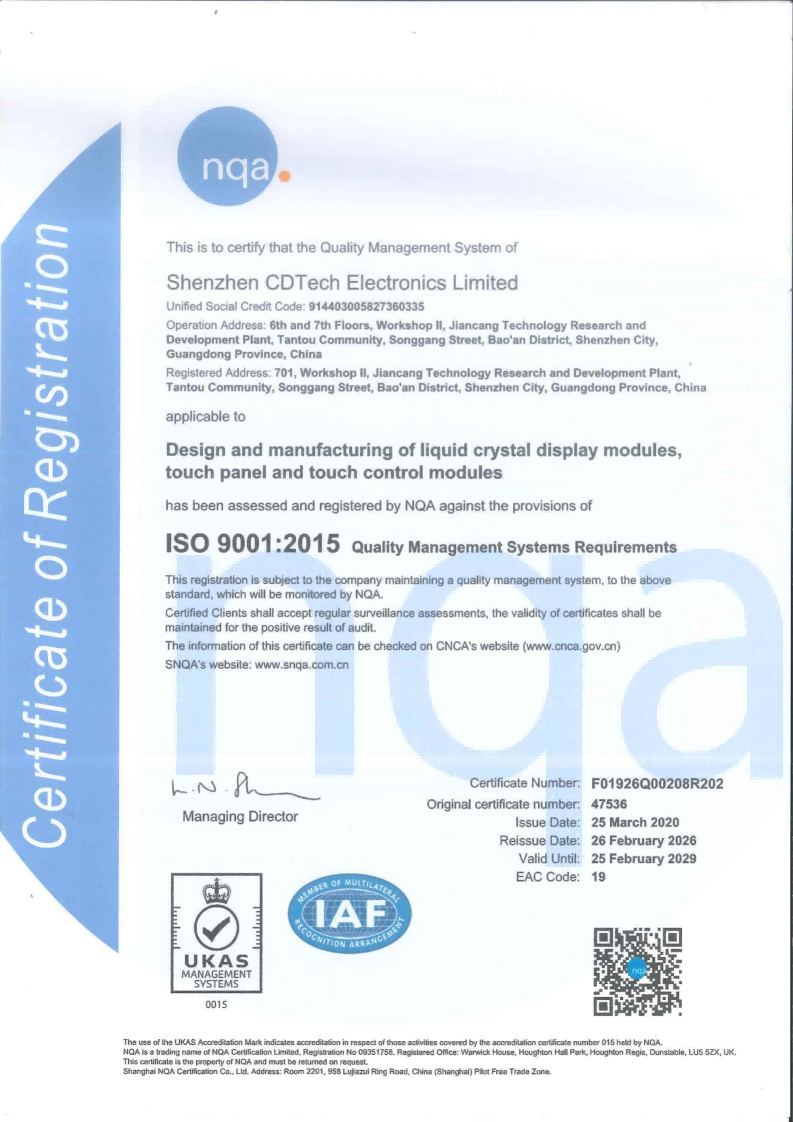
Suppliers that understand this provide a component documentation package rather than claiming approvals they cannot hold. For a display factory, the certificates that genuinely apply are quality-system certificates, not product approvals.
CE marking: which directives apply
The applicable directives depend on what the product does.
A display product placed on the EU market typically falls under the EMC Directive, and under a safety framework depending on its function and its supply. Products with wireless interfaces add radio equipment requirements, and products with specific functions – medical, machinery, hazardous area – add their own. The CE marking route involves a declaration of conformity and a technical file with the evidence behind it.
The relevant frameworks are documented by the European Commission, including the EMC Directive and the general CE marking guidance. The display’s contribution is its emissions and immunity behaviour, documented in the configuration used.
RoHS, REACH and the EU GPSR
Substance and safety obligations arrive with the material list.
RoHS restricts substances in electrical equipment and requires evidence about the materials in the assembly. REACH concerns chemical substances, including the obligation to communicate information about substances of very high concern. General product safety obligations in the EU add requirements on traceability and on the identification of the economic operator placing goods on the market. Together they mean the display supplier should be able to provide a material declaration covering the front assembly, the printed layers and the electronics.
The frameworks are published by the European Commission, including the RoHS Directive and the REACH Regulation. Where a supplier cannot provide a material declaration, the buyer has to obtain the data from sub-suppliers, which is slower and less reliable.
EMC and safety standards by region
Regional frameworks differ in detail and converge in intent.
| Market | Typical framework | Display contribution |
|---|---|---|
| European Union | EMC and safety directives, CE marking | Emissions and immunity data; internal safety design |
| United Kingdom | UKCA marking under equivalent regulations | Same evidence, separate marking and declaration |
| United States | FCC rules for unintentional radiators; safety via NRTL listing | Emissions behaviour; safety construction |
| Canada | ISED rules and provincial safety requirements | Same emissions evidence, different process |
| Other markets | National schemes, e.g. CCC in China | Product-level approval; component data supports it |
The internal electronics safety standard commonly used for information equipment is IEC 62368-1, and its national equivalents underpin safety listings. Where the product is installed in a specific environment, additional frameworks apply: ingress protection levels are defined in IEC 60529, and hazardous-area equipment falls under schemes documented by IECEx.
UL, CSA and North American requirements
Listing is about the product, not the panel.
In North America, safety approval is typically achieved by listing the finished product with a recognised laboratory, which evaluates the construction, the components and the marking. The display’s contribution is its construction – insulation, spacing, temperature rise and, for some products, fire behaviour of the materials. Components with their own recognised approval simplify the evaluation, so asking a display supplier for the component approval status is worthwhile when the finished product will be listed.
Laboratories such as UL Solutions publish the applicable standards for information technology equipment and for the components used in it.
UKCA and post-Brexit duplication
Two markets, two sets of paperwork.
The United Kingdom maintains its own marking regime with requirements that mirror the EU framework, which means a product sold in both markets needs both declarations and, in practice, evidence that satisfies both. The evidence itself is usually the same – emissions, immunity, safety construction – but the marking, the declaration and the identification of the responsible economic operator differ.
Buyers often discover the duplication only when preparing the first shipment, which is a poor time to find that the technical file has the wrong operator details in it. Planning for both markets at the start costs little.
Reading certificates, reports and declarations
Three document types, three purposes.
- A certificate attests to a management system or to a component approval, and it has a scope and a validity period.
- A test report records measurements made on a specific sample in a specific configuration.
- A declaration of conformity is the manufacturer’s own statement, and it lists the standards applied.
Confusing these leads to the common error of treating a test report as an approval, or a management-system certificate as evidence about a product. When reviewing supplier documents, check what each one actually attests to before it is placed in a technical file.
Verifying a certificate is genuine and current
Two checks close most of the risk.
First, confirm the certificate with the issuing body or through an accreditation register rather than accepting a scanned copy, because superseded and out-of-scope certificates circulate. Second, check the scope statement against the site and product line being purchased, since a company can hold a certificate for one facility and manufacture elsewhere. Bodies such as the International Accreditation Forum and ILAC publish how accredited certification and laboratory accreditation work, which is what makes a register check meaningful.
For materials, a declared composition without supporting test data should be treated as a claim rather than evidence. Third-party laboratory results from bodies such as SGS or Bureau Veritas carry more weight where restricted substances are concerned.
What to ask a supplier before you quote a customer
Six questions produce the answers a compliance team needs.
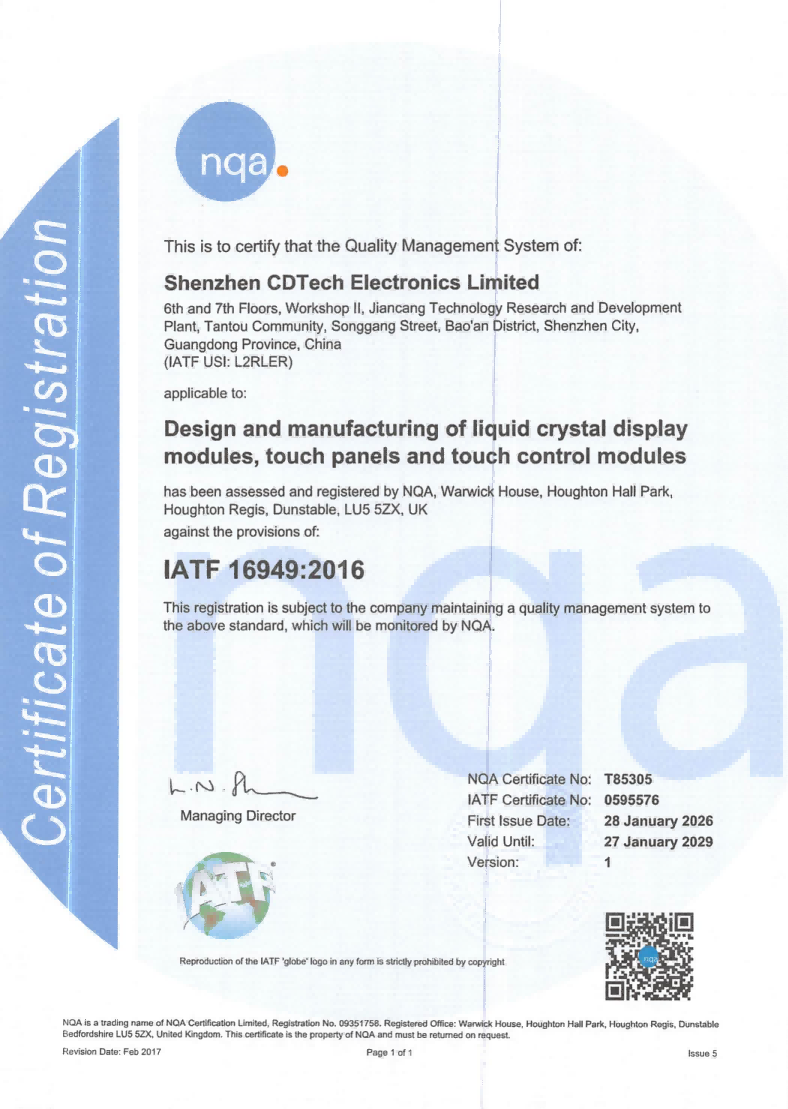
- Which quality-system certificates do you hold, with scope and validity?
- Can you provide a material declaration for the front assembly and the electronics?
- What EMC test configuration was used, and can you supply the report?
- What is the component approval status of the module and its driver board?
- What change notification applies, and does it cover materials and production site?
- What product approvals does the module hold, as distinct from the finished equipment?
Answers to these come back quickly from a supplier that works with regulated customers, and the absence of an answer is itself informative. Substance and substance-declaration documents referenced above are all public frameworks, and CDTech’s own scope is published on its quality certifications page.
FAQ
Does a display need CE marking?
The finished product placed on the EU market needs CE marking under the applicable directives; the display is a component and does not carry its own CE marking. What the display contributes is the electrical, material and safety evidence that the manufacturer’s technical file requires.
What certifications should an LCD display have?
A quality-system certificate such as ISO 9001 for the manufacturing site, plus the component data needed for the finished product’s approval: supply characteristics, material declarations, EMC behaviour and, where relevant, component safety approvals. Product approvals belong to the equipment, not to the panel.
How do I verify that a supplier certificate is genuine?
Check it with the issuing body or an accreditation register rather than accepting a scan, and read the scope statement to confirm it covers the site and product line you are buying. For material declarations, treat unsupported claims as claims and ask for laboratory data.
What is the difference between a test report and a certificate?
A test report records measurements on a specific sample in a specific configuration; a certificate attests to a management system or a component approval with a scope and validity period. A test report is not an approval, and a management-system certificate says nothing about product performance.
Do I need UKCA in addition to CE marking?
For products sold in both the EU and Great Britain, yes: the evidence is usually the same, but the marking, the declaration and the identification of the responsible economic operator differ. Planning for both at the start avoids finding the gap when preparing a first shipment.
Next step
Send the target markets, product category and intended use to CDTech; the reply will list the component evidence available for the display module and identify what the product approval will require from other sources.
Contact sales@cdtech-lcd.com or use the contact page.
Related articles
 Second-Source Qualification for Display Modules Without Doubling Your Inventory RiskQuality, Testing & Compliance
 Incoming Inspection for Display Modules: What to Check and How OftenQuality, Testing & ComplianceEMC Certification for Display Products: Passing the First TimeQuality, Testing & Compliance
 Screen Damage Modes: Distinguishing Production Defects From Field DamageQuality, Testing & Compliance