Incoming Inspection for Display Modules: What to Check and How Often
Incoming inspection for display modules: what to check, how often, sampling plans, fixtures and how to handle borderline results without slowing production.

Incoming inspection has two failure modes: too little, so defects reach production, and too much, so a receiving bay becomes a bottleneck that adds no information. The balance depends on what the supplier already verifies, what a defect costs downstream, and how variable the product is. This is how to design a programme that catches real problems.
Part of the Quality, Testing & Compliance guide — 33 articles on defect classes, inspection, qualification and certification.
What the supplier already inspects
Start by finding out what the certificate of conformity means.
Before designing an incoming programme, establish what the supplier tests per unit and what it samples: optical performance, appearance, function and packaging. A supplier with automated optical inspection on every unit and a defined cosmetic standard provides evidence that changes what the buyer needs to check. The supplier’s inspection flow and the certificate of conformity contents are the starting point for deciding the buyer’s own scope – not a reason to skip inspection, but a reason to focus it.
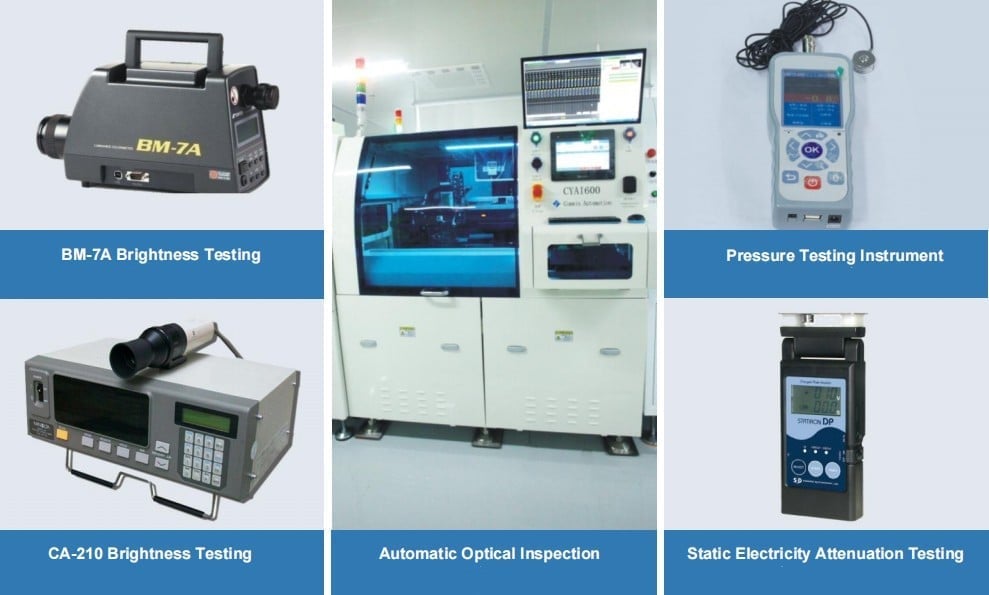
CDTech’s inspection chain runs from incoming material through in-process, quality assurance, final, functional and visual checks to outgoing inspection, and that flow is part of the evidence a buyer can request. What matters at receiving is the difference between the supplier’s verification and the buyer’s requirements.
Checks that catch most real problems
A short list, done consistently.
| Check | Method | Why |
|---|---|---|
| Packaging and labelling | Visual, against the drawing | Prevents part mix-ups and transit damage reaching the line |
| Part number and revision | Label and marking check | Catches substitutions and superseded revisions |
| Cosmetic appearance | Defined illumination, boundary samples | Catches scratches, print defects and mura |
| Function at nominal supply | Power-up on a test fixture | Catches dead-on-arrival units |
| Optical spot check | Luminance and uniformity at defined points | Catches degradation or a changed stack |
| Touch response | Grid test with the fixture | Catches tuning and configuration mismatches |
| Connector and FPC condition | Visual under magnification | Catches handling damage and contamination |
The fixture matters as much as the checklist: a receiving fixture that powers the module, displays a defined pattern and provides a known touch stimulus turns several checks into one repeatable operation.
Sampling: how often and how many
Sampling follows risk, not habit.
Where a defect would stop a production line, full inspection of that characteristic is justified; where it would cause a return but not a stoppage, sampling is appropriate. Acceptance sampling schemes allow the sample size and acceptance number to be defined against an acceptable quality level, and ASQ maintains reference material on the method. The practical refinements are to sample more heavily for the first lots of a new supplier or revision, and to reduce frequency once a stable record exists.
Frequency should also follow production volume: a customer assembling ten units a week can inspect all of them, while one assembling thousands needs a plan with a defined sample size per lot.
Fixtures and test patterns
Inspection quality is limited by the fixture.
A receiving fixture should provide a stable supply, a defined test pattern that exercises every channel and shows uniform fields, a mounting that does not introduce stress, and controlled illumination for the cosmetic check. Where touch is involved, the fixture should provide a repeatable stimulation method – a mechanical actuator or a defined contact grid – so results do not depend on the operator’s finger. Building the fixture once and documenting its configuration is what makes results comparable between shifts and sites.
Where the display is bonded, the fixture should also allow inspection of the front at a defined angle, since bonded assemblies show different defects depending on viewing geometry.
Handling borderline results
Borderline decisions need a rule, not a discussion.
The workable rule is to compare against the boundary sample: at or within the limit passes, outside it fails, and where the defect is not covered by the standard the unit is set aside for a documented decision rather than passed by default. Recording those decisions and updating the standard where it was ambiguous converts a recurring argument into a one-time clarification. Where a borderline defect appears at a consistent rate, the cause is usually a process drift that the supplier should investigate.
Keeping rejected units for the supplier’s analysis – rather than scrapping them locally – is what makes the feedback loop work, since the analysis needs the physical evidence.

Record keeping and trends
The value of inspection is in the trend.
Recording results per lot, with the characteristic and the outcome, allows a drift to be detected before it produces a rejection and provides the data for a supplier conversation. The useful fields are lot identity, sample size, defect category, defect rate and disposition. Where a defect rate rises gradually, the corrective action is often a process adjustment at the supplier rather than a change to the specification.
Trends also show when inspection can be reduced: a characteristic with no defects over many lots is a candidate for reduced frequency, which frees capacity for the characteristics that do vary.
What not to inspect at receiving
Some checks belong elsewhere.
- Long-term reliability characteristics, which are type-test rather than lot-test items.
- Environmental performance, which cannot be assessed on production units without destroying them.
- Characteristics fully verified by the supplier’s automated inspection, unless there is evidence that the verification is unreliable.
- Items requiring specialised equipment the receiving area does not have, which are better handled by periodic audit samples at a laboratory.
Excluding these keeps the receiving programme focused on what it can actually detect. Where a characteristic needs laboratory assessment, a periodic audit sample is a better mechanism than an inadequate check at the receiving bay.
Working with the supplier on defects
Feedback needs evidence and a channel.
The effective loop provides the supplier with the lot identity, the defect category, photographs at a defined magnification and, where possible, the physical units. In return the supplier reports the cause and the corrective action, and the buyer verifies the effect on subsequent lots. Where the defect is cosmetic and the standard was ambiguous, the outcome is usually a clarification of the standard rather than a process change, which is why keeping the standard under revision control matters.
Where the defect indicates a process or material change the buyer was not told about, the change notification agreement is the instrument that prevents recurrence. CDTech’s notes on second-source qualification describe the evidence set a supplier should provide when a source or process changes.
Designing the programme for the production rate
Match the programme to the line, not to an ideal.
- List the characteristics that can cause a line stoppage or a field return.
- Determine which of them the supplier already verifies per unit.
- Choose the smallest check set that covers the remainder.
- Set sample sizes and acceptance numbers against the risk of each characteristic.
- Build a fixture that makes the check repeatable.
- Record results per lot and review the trend regularly.
Reviewing the programme periodically, and reducing inspection where the record justifies it, keeps the receiving bay from becoming a permanent cost with no marginal benefit. General quality practice for acceptance sampling is described in resources from ASQ, and workmanship expectations for the electrical assembly are published by IPC.
FAQ
What should be checked when display modules arrive?
Packaging and labelling against the drawing, part number and revision, cosmetic appearance under defined illumination, function at nominal supply, an optical spot check, touch response and the condition of the connector and FPC. A receiving fixture that performs several of these in one operation is the practical way to do it.
How many units should be inspected per lot?
The sample size follows the risk: full inspection for characteristics that would stop a line, and sampling with a defined acceptance number for those that would not. Inspect more heavily for the first lots of a new supplier or revision, and reduce frequency once a stable record exists.
Is incoming inspection necessary if the supplier certifies the goods?
A certificate of conformity reports what the supplier verified, which changes what the buyer needs to check but does not remove the need entirely. Establish what is verified per unit, then inspect the remainder – particularly the characteristics that affect your own production and the ones that have caused problems before.
What should be done with rejected units?
Keep them for the supplier’s analysis rather than scrapping them locally, and provide the lot identity, defect category and photographs. A defect that indicates an unreported process or material change should trigger the change notification process rather than a one-off credit.
Next step
Send the module specification, production rate and the defects that concern you to CDTech; the reply will state what is verified per unit at the factory and propose a receiving inspection scope that covers the remainder.
Contact sales@cdtech-lcd.com or use the contact page.
Related articles
 Second-Source Qualification for Display Modules Without Doubling Your Inventory RiskQuality, Testing & ComplianceEMC Certification for Display Products: Passing the First TimeQuality, Testing & ComplianceScreen Damage Modes: Distinguishing Production Defects From Field DamageQuality, Testing & ComplianceScreen Streaks and Line Defects: Source and DetectionQuality, Testing & Compliance