Which LCD Factory Certifications Actually Matter?
Factory certificates describe an organisation's management system; they do not approve a product. This page covers the four certificates that appear on display factory quality pages, what each one actually covers, and what it…
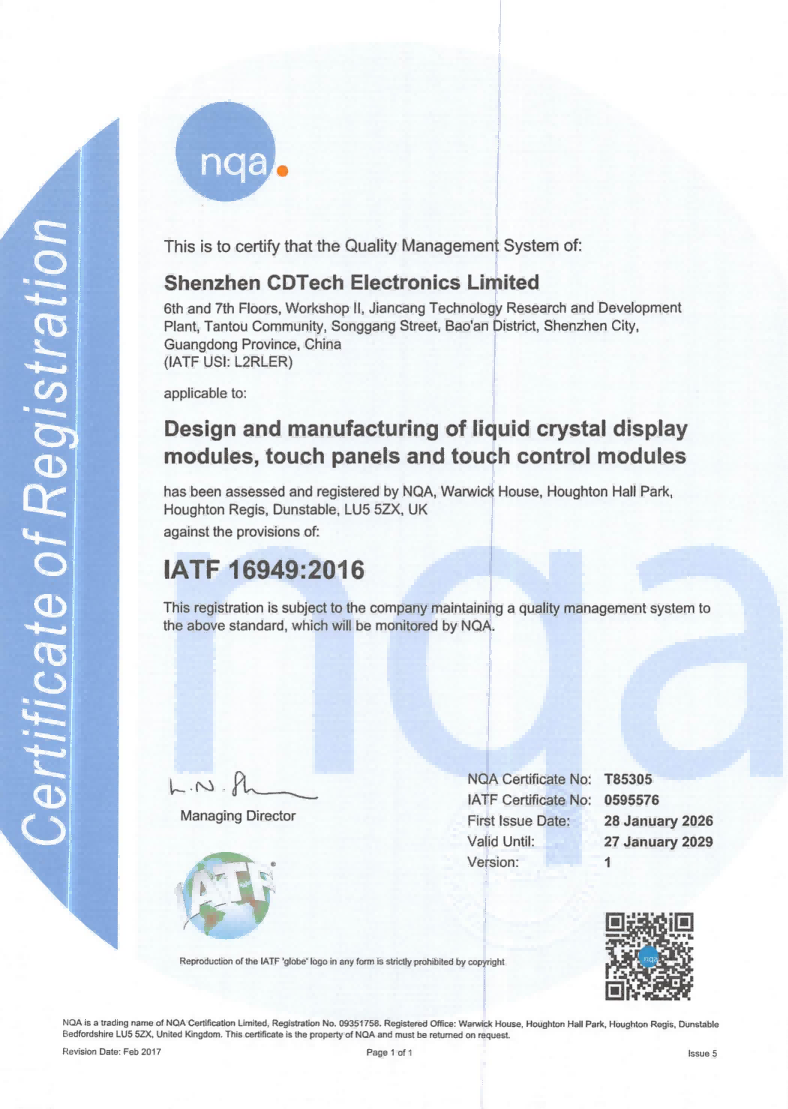
Factory certificates describe an organisation’s management system; they do not approve a product. This page covers the four certificates that appear on display factory quality pages, what each one actually covers, and what it tells a buyer. The other half of the picture – product compliance by market, and how to verify a document is genuine and current – is covered in Which Display Certifications Actually Matter for Your Market.
Part of the Quality, Testing & Compliance guide — 34 articles on defect classes, inspection, qualification and certification.
ISO 9001: the baseline quality system
ISO 9001 covers a documented quality management system: process control, corrective action, internal audit and supplier management. For a display factory it indicates that production, inspection and change processes exist in a documented form. It is the baseline expectation rather than a differentiator, and its value to a buyer lies in what the audit trail behind it can demonstrate.
What it does not tell you is whether the factory can meet a specific optical, environmental or traceability requirement.
ISO 14001: environmental management
ISO 14001 covers environmental management: how the organisation identifies and controls the environmental aspects of its operations, including waste, emissions and chemical handling. For a display factory working with solvents, adhesives and glass processing, it is evidence that those aspects are managed rather than informal.
It is rarely the deciding certificate for a buyer, but it is relevant where a customer’s own environmental reporting requires supply-chain information.
ISO 13485: medical supply
ISO 13485 is the quality system standard for medical device supply: design control, production control, traceability, corrective action and supplier management as applied to the organisation’s own products. A display factory holding it can support a medical device customer’s audit and documentation obligations.
Its scope statement is the part to read, because a certificate can cover one facility or one product line.
IATF 16949: automotive supply
IATF 16949 is the automotive quality management system standard, built on ISO 9001 with additional requirements for defect prevention, process capability, traceability and change control. For display modules it is the certificate most often requested by tier-1 automotive customers, and it implies the APQP and PPAP discipline that automotive programmes expect.
As with ISO 13485, the practical question is whether the site and product line being purchased fall inside the certificate’s scope.
How to read a factory certificate
Three fields matter: the scope statement, which names the site and the activities covered; the validity period, because certificates expire and are re-issued; and the issuing body, which should be an accredited certification body. A certificate quoted for a group while the manufacturing happens elsewhere is the most common mismatch found in display supply. Accreditation registers that make the check possible are described by the International Accreditation Forum and ILAC, and third-party testing scopes are published by bodies such as Intertek.
For product-level approvals, a different set of documents applies, and those belong to the equipment rather than to the panel.
Where to go next
For the product-compliance side – CE and UKCA, RoHS and REACH, EMC and safety by region, UL listing, and how to verify a certificate through an accreditation register – read Which Display Certifications Actually Matter for Your Market. Related: medical display requirements and RoHS, REACH and conflict minerals documentation.
FAQ
Does an ISO 9001 certificate guarantee display quality?
No. It confirms that a documented quality system exists, not that any particular requirement is met. Its practical value is that the audit trail behind it – incoming records, process parameters, inspection results – should exist and be reconstructable.
Which factory certificate matters most for automotive displays?
IATF 16949, because it carries the automotive-specific requirements for process capability, traceability and change control that tier-1 customers rely on. Confirm that the certificate’s scope covers the site and product line you are buying from.
What does ISO 13485 add for a display buyer?
It is the quality system standard that medical device customers expect of their suppliers, covering design control, production control, traceability and corrective action as applied to the supplier’s own products. It does not approve the device, which remains the manufacturer’s obligation.
Next step
Ask CDTech for the current certificate set with scope and validity for the site and product line you intend to buy from; write to [email protected] or use the contact page.
Related articles
 Second-Source Qualification for Display ModulesQuality, Testing & Compliance
 Second-Source Qualification for Display Modules Without Doubling Your Inventory RiskQuality, Testing & Compliance
 Incoming Inspection for Display Modules: What to Check and How OftenQuality, Testing & ComplianceEMC Certification for Display Products: Passing the First TimeQuality, Testing & Compliance