Medical Display Cleaning and Disinfection: Choosing Surfaces That Survive the Protocol
Medical display cleaning and disinfection: what alcohol, quaternary ammonium and peroxide do to polarizers, coatings and adhesives, and how to test a claim.
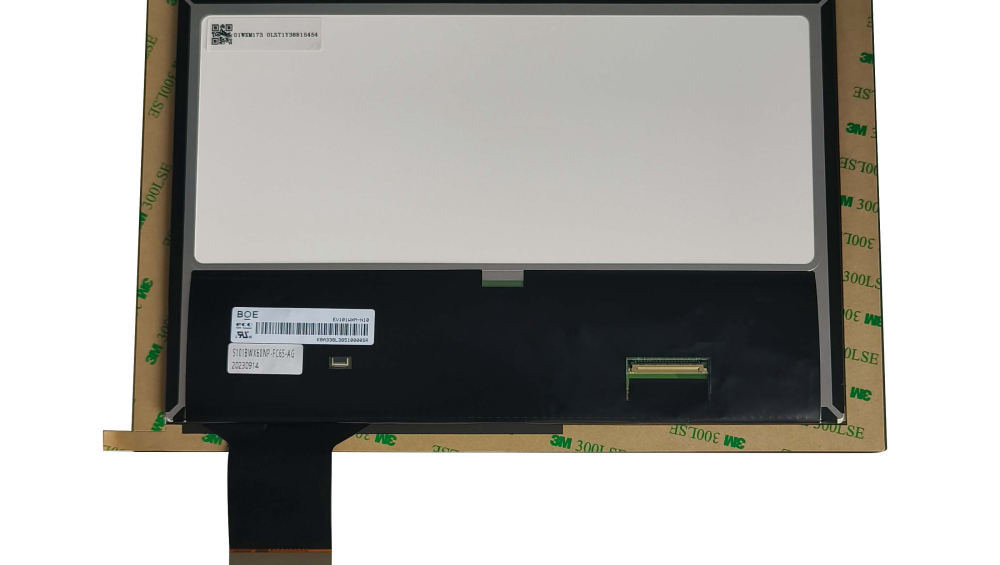
Hospital displays are not damaged by use; they are damaged by cleaning. A device that is wiped several times a shift accumulates hundreds of chemical exposures a year, and the materials that fail first – print, coating, adhesive edge – are not the ones engineers think of as the front surface. Understanding which material is attacked by which agent is what turns a cleaning protocol into a specification.
What disinfectants do to polarizers, coatings and adhesives
Each agent attacks a different material in the stack.
Alcohols dissolve some printed inks and soften pressure-sensitive adhesives over repeated exposure, but evaporate quickly and leave little residue. Quaternary ammonium compounds leave a film that can affect both appearance and touch behaviour, and some formulations attack certain coating chemistries. Chlorine-releasing solutions are effective but aggressive to adhesives and to some bezel plastics, and hydrogen peroxide formulations are generally gentler on polymers while still oxidising printed layers over time.
The important point for specification is that the vulnerable components are the ones inside the front assembly, not the glass. A compatibility matrix by material and by agent, supplied with the front assembly, is more useful than a general statement of resistance.
Alcohol, quaternary ammonium and hydrogen peroxide compared
Compare them on the materials, not on their disinfectant performance.
| Agent family | Typical residue | Main material risk | Practical note |
|---|---|---|---|
| Alcohol-based | Very low, fast evaporation | Printed inks, adhesive softening | Common and usually well tolerated; watch print edges |
| Quaternary ammonium | Film-forming | Coating chemistry, residue on touch surface | Residue changes friction and coupling; may need a rinse step |
| Chlorine-releasing | Low if rinsed | Adhesives, bezel plastics, print | Effective; requires material compatibility data |
| Hydrogen peroxide | Low | Oxidation of printed layers over time | Generally polymer-friendly; still test repeated cycles |
No family is universally safe, and the same agent at a different concentration behaves differently. Write the concentration and contact time into the requirement, because that is what the test will reproduce.
Wipe vs spray: mechanical wear on coatings
Half the damage comes from the cloth.
Wiping applies both chemistry and abrasion: the cloth type, the pressure and the number of passes determine how quickly a coating wears. Abrasive pads used to remove dried residue scratch the surface and accelerate haze growth, and the area most affected is where the clinician’s hand rests. A spray-and-wipe with a soft, lint-free cloth is gentler than a heavy repeated scrub with a rough one.
The specification consequence is that the cleaning procedure is part of the durability requirement. Testing chemical compatibility with a gentle application and then deploying a rough one invalidates the test.
Cover glass vs film: which survives daily protocol
Film fronts fail at the edges.
Film-based surfaces are inexpensive and replaceable, but they lift at the edges after repeated chemical exposure and mechanical wiping, and the lifted edge traps fluid and debris. A glass front with a bonded edge resists both, at higher cost and with the implication that the whole front assembly is the service part. Where a device must survive years of protocol-level cleaning, glass with no exposed adhesive edge is the more durable choice.
Where a film or coating is used, specify it as a wear item with a replacement interval rather than assuming it lasts the device’s life.
Edge sealing and liquid ingress paths
The edge is where cleaning fluid becomes an ingress problem.
Fluid pools at the boundary between glass, bezel and gasket, and a capillary path at that boundary will eventually draw liquid into the assembly. Continuous adhesive bonding removes the path; a gasketed design depends on compression and on the flatness of the mating surface. Where the assembly is opened for service, the seal is a consumable and should be replaced rather than reused.
Design the front so that liquid runs off rather than standing: a small slope, a recessed bezel and no horizontal ledge. Water traps are also hygiene findings in food and clinical audit contexts, so the geometry serves two purposes.
Fingerprint and glare coatings under chemical attack
The coating is the thinnest and most exposed layer.
Anti-fingerprint coatings reduce smearing where the screen is touched, and anti-glare treatments reduce reflection; both are thin surface layers that can be degraded by repeated chemical exposure and abrasion. The visible symptoms are a hazy patch, a change in friction, or a localised increase in reflectivity in the most-touched area. Measuring haze and gloss before and after a cleaning cycle test is the way to quantify it, using a defined method such as ASTM D1003 for haze.
Where coatings are essential, an alternative is to place them on a replaceable outer layer, accepting the optical cost of an extra interface.
Test method for chemical resistance claims
Reproduce the protocol, then repeat it.
- Name the agent, its concentration and the dilution used in practice.
- Define the application method: spray, pre-saturated wipe, or immersion of the edge.
- Define contact time and whether the surface is rinsed afterwards.
- Define the number of cycles: at least the number expected in a year of service.
- Measure haze, gloss and transmission before and after.
- Inspect the print edge, the adhesive boundary and the coating under magnification.
Run the test on production assemblies rather than on bare glass coupons, because the failure modes that matter involve the layers behind and around the glass. CDTech’s guidance on medical display cleaning and cover glass covers the practical application of this method.
Writing a cleaning procedure that protects the device
The procedure is part of the product, not an afterthought.
A cleaning procedure that names the approved agents, the dilution, the cloth type and the contact time protects the device, the warranty and the patient. It should also state what is not allowed: abrasive pads, solvent blends, immersion and spraying directly into seams. Where the device is cleaned by many people, a laminated card at the point of use is more effective than a section in a service manual.
Good practice is to derive the procedure from the test that was actually run, so that every approved step has evidence behind it and every unapproved step is excluded for a stated reason.
What to do when a hospital adopts a new disinfectant
Treat a new agent as a change, not as a surprise.
Hospitals change disinfectants for reasons that have nothing to do with displays: supply contracts, infection-control policy, resistance concerns. When that happens, the device owner needs an assessment rather than an assumption. The practical response is to obtain the new agent’s chemistry and concentration, compare it against the front assembly’s compatibility matrix, and where it is not covered, run a shortened cycle test on a spare assembly before fleet-wide adoption.
Manufacturers can make this cheap by publishing the compatibility matrix with the device documentation and by keeping the front assembly as a stocked spare.
Specification clauses that prevent later disputes
Write down what will be cleaned with what.
- Named cleaning agents, concentration and contact time, with the test evidence referenced.
- Approved cloth types and application method, including a prohibition on abrasives.
- Materials list for the front assembly with per-material compatibility.
- Sealing method statement, with the service procedure for reopening and re-sealing.
- Coating specification with the wear criteria and the measurement method.
- Procedure for assessing a new agent, including the accepted shortened test.
These clauses are cheap to write and prevent the most common commercial dispute in medical display supply, which is a device returned for surface damage caused by a cleaning agent that was never specified. CDTech’s quality certifications page lists the quality-system scope that supports this kind of documented programme.
FAQ
Can I use alcohol wipes on a medical monitor screen?
Usually, for glass-fronted displays, because alcohol evaporates quickly and leaves little residue. The risk is to printed inks and to adhesives at the edge over repeated exposure, so confirm the front assembly materials are compatible and avoid excess liquid that can be drawn into seams.
Which chemicals damage LCD screens?
The damage is usually to the print, coating and adhesive rather than the liquid crystal: chlorine-releasing agents and strong solvents attack adhesives and printed layers, abrasive pads scratch coatings, and film fronts lift at the edges. Ammonia-based glass cleaners are a common cause of coating haze on consumer screens.
How do I test whether a display survives a cleaning protocol?
Reproduce the agent, concentration, application method, contact time and rinse step, then repeat for at least the number of cycles expected in a year, measuring haze and gloss before and after and inspecting the print edge and adhesive boundary under magnification. Test production assemblies, not bare glass.
What should a hospital do when it changes disinfectant?
Treat it as a specification change: identify the new chemistry and concentration, compare it with the device’s compatibility data, and run a shortened cycle test on a spare front assembly if the agent is not covered. Doing this before fleet-wide adoption avoids discovering the incompatibility across the whole estate.
Next step
Send the cleaning agents, dilution and wiping method used at your site to CDTech; the reply will state which front assembly materials are compatible and what cycle testing is required.
Contact sales@cdtech-lcd.com or use the contact page.
Related articles
 ESD Protection for Display Modules: Design, Test and Field RealityInfo
 Hydrogen, Gas and Chemical Process Displays: Where Certification Drives the DesignInfoResistive Touch Screens: Where They Still Beat Capacitive in 2026Info
 Haptic Feedback and Display UX in Industrial Equipment: When Touch Is Not EnoughInfo