RoHS, REACH and Conflict-Minerals Documentation for Display Modules
Substance compliance for a display module is not one document. It is a small set of declarations, each answering a different regulation, each with its own validity period, and each issued by a different…
Substance compliance for a display module is not one document. It is a small set of declarations, each answering a different regulation, each with its own validity period, and each issued by a different party in the supply chain.
This article sets out what each regulation actually asks of a display, what a supplier can and cannot declare, and how to keep the document set current without rebuilding it every year.
What each regulation asks of a display module
Restriction-of-hazardous-substances rules limit the presence of specific substances in electrical and electronic equipment. For a display module the relevant materials are the solder alloys, the glass, the polariser films, the adhesive layers, the flexible circuit substrates and the coatings.
REACH works differently: it does not restrict a material at the point of sale so much as require communication about substances of very high concern above defined concentration thresholds, expressed as a proportion of the article’s mass.
Conflict-minerals reporting is a disclosure obligation rather than a material restriction. It asks where certain metals originated, not whether they are present.
The distinction matters because a supplier may legitimately answer one and not the other. A RoHS declaration says nothing about SVHC content, and an SVHC statement does not address the restricted substances list.
Exemptions that commonly apply
Substance rules carry exemptions, and electronic displays rely on several of them. Exemptions are usually tied to a material or an application rather than to a product, they have expiry dates, and they can be renewed or narrowed.
Two consequences follow for buyers. First, a declaration that cites an exemption is only valid while that exemption is valid, which is one reason declarations have review dates. Second, a supplier who claims full compliance without mentioning an exemption should be asked how the glass, the solder and the coatings meet the limits without one.
SVHC thresholds and communication duties
The obligation is triggered by concentration in the article, not by total mass in the shipment. In a display module, substances are rarely distributed evenly: an adhesive, a coating or a solder joint may exceed a threshold while the module as a whole does not.
This is why a declaration has to be traceable to the level at which the assessment was made. A statement covering the whole module and a statement covering a specific material both have value, but they answer different questions, and a buyer needs to know which one is held.
Conflict-minerals reporting in practice
Reporting follows the smelters and refiners in the supply chain rather than the finished product. A display maker collects information from its own suppliers and passes a summary upwards, and the reliability of the result depends entirely on how far down the chain the information goes.
In practice, buyers should expect a statement that describes the scope and the method rather than an absolute assurance. A declaration claiming perfect traceability for every material in a complex module deserves scrutiny.
The document set and who issues what
| Document | Answers | Typically issued by |
|---|---|---|
| RoHS declaration | Restricted substances and applicable exemptions | The module maker, based on material declarations from its suppliers |
| REACH SVHC statement | Presence above the threshold and communication duty | The module maker, chain up to the material supplier |
| Material declarations | The underlying data behind the statements | Component and material suppliers |
| Conflict-minerals statement | Source and reporting method for the relevant metals | The module maker, based on supplier surveys |
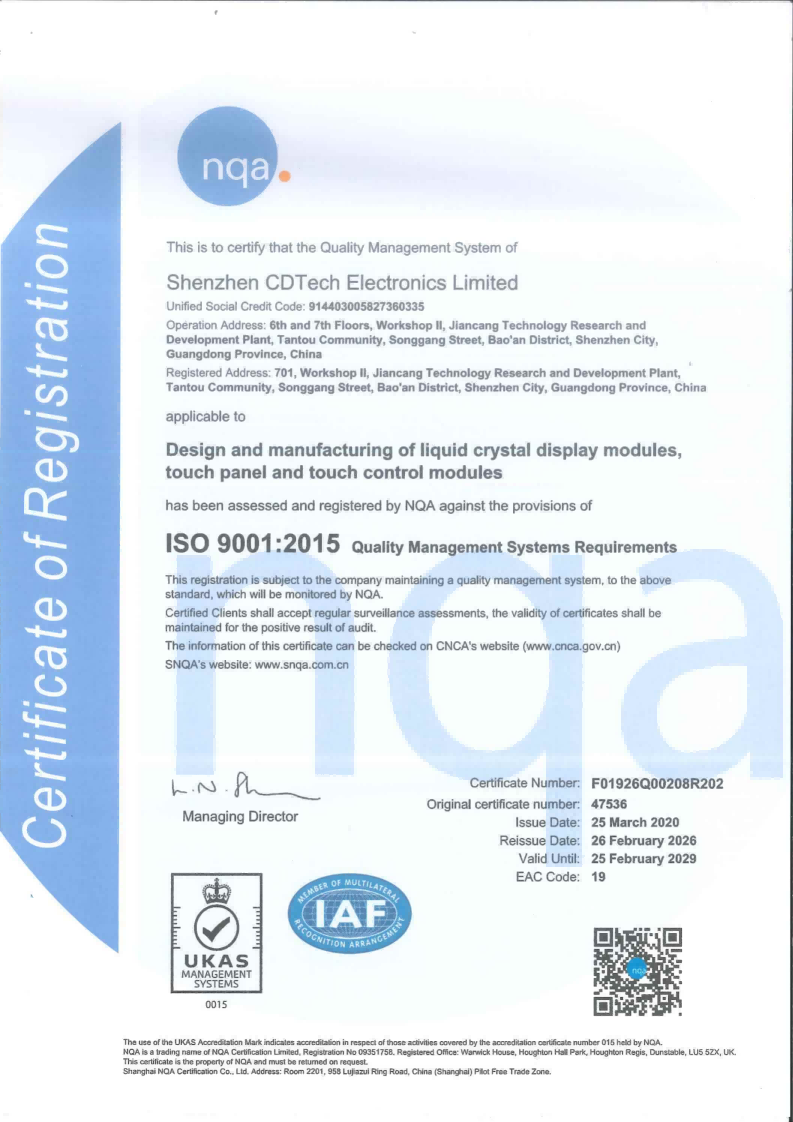
| Quality-system certificate | The manufacturing site’s management system and scope | An accredited certification body |
Which management-system certificates matter for a display programme is a separate question, covered in LCD factory certifications. Two further documents are worth requesting even when they are not formally required: a full material declaration when the product is used in a regulated application, and a change-notification commitment that names your programme.
The quality and certifications page lists the management-system certificates held by CDTech; confirm the scope that applies to your project rather than assuming it covers every product.
Validity periods and refresh triggers
Where a declaration relies on an exemption, track the exemption’s own expiry separately from the declaration’s date. Exemptions are reviewed and sometimes narrowed, and a declaration that cites an expired exemption is not a declaration that still describes the product, even though the document itself has not changed.
Where a declaration relies on an exemption, track the exemption’s own expiry separately from the declaration’s date. Exemptions are reviewed and sometimes narrowed, and a declaration that cites an expired exemption is not a declaration that still describes the product, even though the document itself has not changed.
Where a declaration relies on an exemption, track the exemption’s own expiry separately from the declaration’s date. Exemptions are reviewed and sometimes narrowed, and a declaration that cites an expired exemption is not a declaration that still describes the product, even though the document itself has not changed.
Where a declaration relies on an exemption, track the exemption’s own expiry separately from the declaration’s date. Exemptions are reviewed and sometimes narrowed, and a declaration that cites an expired exemption is not a declaration that still describes the product, even though the document itself has not changed.
Declarations usually carry a date and sometimes an explicit validity period. Even without one, three events invalidate the assumption that a document still describes the product: a change to a material, a change to the manufacturing site, and a change to the regulation or an exemption.
A practical rule is to give every declaration a review date of its own, driven by the regulation rather than by the supplier’s document cycle. Substances and exemptions change on their own timetable, and a declaration that was correct when issued may be misleading two years later.
Collecting documents across the supply chain
Collection is where most compliance programmes stall, because the information originates several tiers below the supplier you buy from. Three practices help.
Ask for the document set as part of the quotation rather than after the order. Name the specific documents rather than asking for “compliance”. And keep a register that records, for each part number, which documents are held, their dates, and which ones are missing – so a gap is visible rather than discovered during an audit.
When a supplier or material changes
A material change at a sub-supplier can invalidate a declaration without anyone intending it. The defence is a change-notification arrangement that covers material changes as well as product changes, and a requirement that the declaration be re-issued when a material changes.
Where a product is used in a regulated application, the change also has to be assessed against the device’s own documentation, which is why the notification commitment matters more than the declaration itself.
Audit readiness
Auditors typically sample rather than read everything. They pick a part number, ask for the documents that apply to it, and then follow one of those documents back to its source. A register that links part numbers to documents, dates and sources survives that process; a folder of PDFs does not.
Auditors typically sample rather than read everything. They pick a part number, ask for the documents that apply to it, and then follow one of those documents back to its source. A register that links part numbers to documents, dates and sources survives that process; a folder of PDFs does not.
Auditors typically sample rather than read everything. They pick a part number, ask for the documents that apply to it, and then follow one of those documents back to its source. A register that links part numbers to documents, dates and sources survives that process; a folder of PDFs does not.
Auditors typically sample rather than read everything. They pick a part number, ask for the documents that apply to it, and then follow one of those documents back to its source. A register that links part numbers to documents, dates and sources survives that process; a folder of PDFs does not.
An auditor will ask three things: which documents you hold, how you know they are current, and what happens when something changes. A register with dates, a defined review trigger and a change-notification arrangement answers all three.
What creates problems is a folder of PDFs with no index, no dates and no link to part numbers. The documents may all be present and still fail the question, because nobody can demonstrate that they apply to the product in production today.
Setting the refresh cycle for compliance documents
Set the cycle from the regulation and the product’s risk rather than from convenience: review high-risk materials annually, review the whole set whenever a regulation or exemption changes, and re-issue on any material or site change. Record the review date in the register so the next cycle is triggered by data rather than by memory.
If your programme needs the document set assembled for a specific product, describe the part numbers and the destination market and we can confirm which documents apply. For the wider compliance picture, see the article on failure analysis and quality records, which follows the same traceability discipline.
Frequently asked questions
Is a RoHS declaration the same as a REACH statement?
No. They address different obligations – restricted substances versus communication about substances of very high concern – and one does not substitute for the other.
How long is a material declaration valid?
Until a material, a manufacturing site or the regulation changes. Assign your own review date rather than relying on the document’s issue date.
Do we need full material declarations for every part?
Usually not. They become valuable when the product is used in a regulated application or when a specific substance is under scrutiny.
Related articles
 OLED Versus LCD for Industrial HMI: Lifetime, Burn-In and FitInfo
 Display Timing Parameters Explained: Pixel Clock, Blanking and Sync for PractitionersInfoCustom Medical Displays: DICOM, Grayscale and Panel Selection ExplainedInfo
 Ventilator and Infusion Pump Displays: Design Constraints Nobody DocumentsInfo